Threat intel5 min read
CISA flags exploited Puppet Enterprise flaw CVE-2026-115731
Attackers are exploiting a critical report-deserialization bug in Puppet Server. Upgrade Puppet Enterprise to 2023.8.13, 2025.12.1 or 2026.0.1 and review autosigning.
4Tify Team
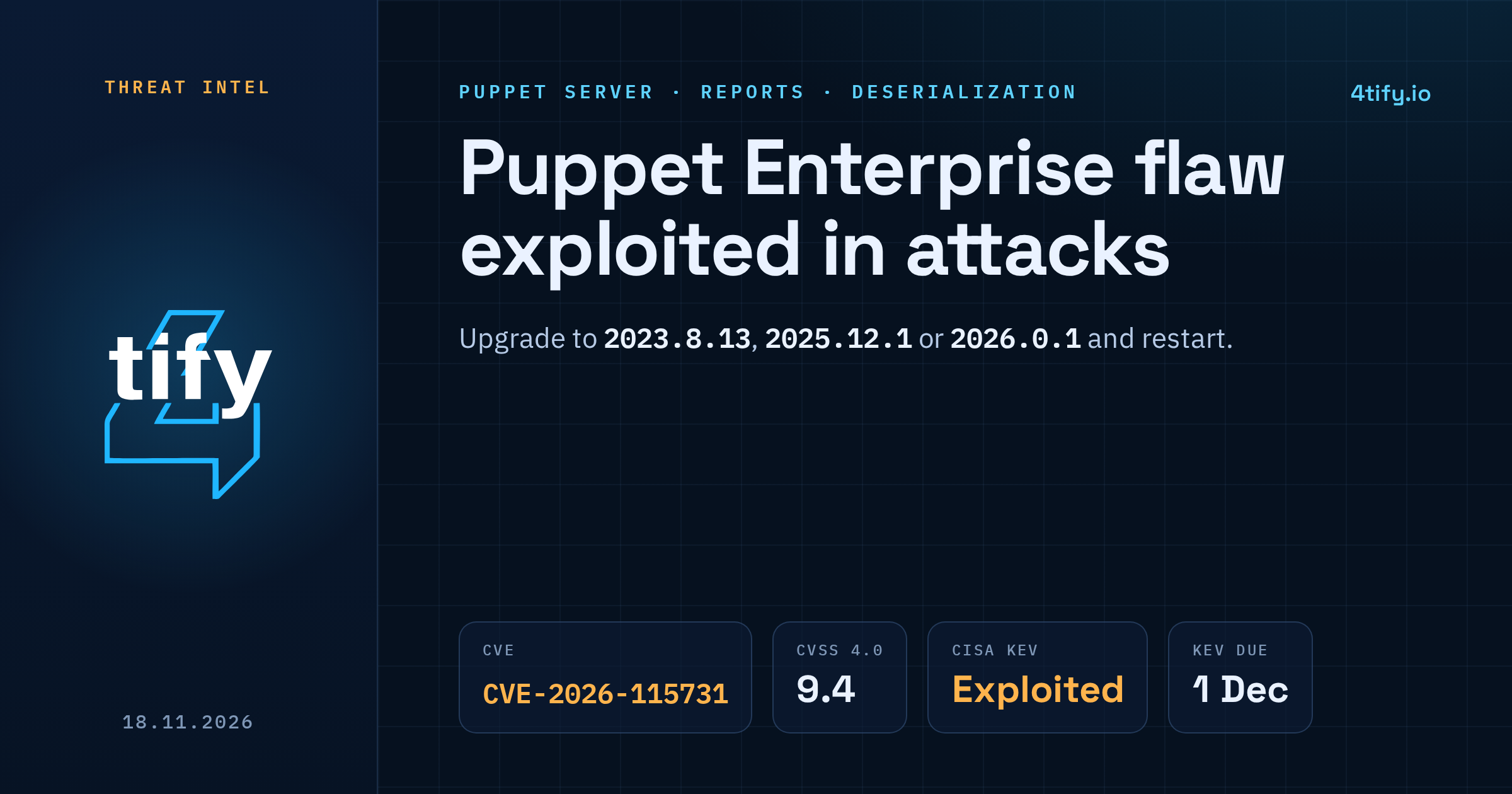
CISA added CVE-2026-115731, a critical bug in Perforce Puppet Enterprise, to its Known Exploited Vulnerabilities catalog on 17 November 2026. A client holding a valid agent certificate can run arbitrary commands on the Puppet Server just by sending it a crafted run report. US federal civilian agencies have until 1 December to fix it. Everyone else running Puppet should treat it as urgent too.
What happened
Perforce published the flaw on 3 November with a CVSS 4.0 score of 9.4. NVD rates it 9.9 under CVSS 3.1. Fixed releases shipped the same day, in a release coordinated with the OpenVox project, the community fork of open-source Puppet, which shares the vulnerable code.
Two weeks later CISA moved it into the KEV catalog, which means the agency has evidence of real attacks. CISA has not said who is behind them or how many organisations were hit, and the catalog lists ransomware use as unknown.
There is another reason to move fast. The OpenVox GitHub advisory includes a complete example report that triggers the bug, so working exploit material has been public since disclosure day.
Who is affected
Puppet Enterprise releases in these ranges are vulnerable:
- 2023.8.0 up to 2023.8.12 (fixed in 2023.8.13)
- 2025.0.0 up to 2025.12.0 (fixed in 2025.12.1)
- 2026.0.0 (fixed in 2026.0.1)
The fixed Enterprise builds bundle puppet-agent 8.22.2 or 9.1.3. The NVD entry also lists the Puppet 8.x line before 8.22.2 and 9.x before 9.1.3. On the OpenVox side, the fixes are in OpenVox Server 9.2.0 and 8.18.0 and OpenVox Agent 9.3.0 and 8.32.0. Red Hat also rates the issue critical for Satellite, which takes client reports over the network by default.
How the attack works
After every run, a Puppet agent sends a JSON report to the server through PUT /puppet/v3/report. Some report events can carry Puppet "rich data" objects, which the server turns back into live objects. The server did not limit which types it would build. A malicious type definition in the report ends up being evaluated as Ruby on the server, running as the Puppet Server service account.
The attacker needs a certificate signed by the Puppet CA. That sounds like a high bar, but many sites switch on autosigning so new machines can join without manual approval. If the CA signs requests without strong checks, an attacker with network access can enrol a fake node and get a certificate with no prior credentials.
The Puppet Server is a bad place to lose control of. It holds the CA signing key and decides what configuration every managed machine applies, so one compromised server can affect the whole fleet.
A second critical flaw fixed in the same releases, CVE-2026-115732 (CVSS 9.0), lets a node whose certificate name is a longer or shorter version of an authorised hostname pass as that host. In Puppet Enterprise that can lead to CA administration access and command execution on managed nodes. It is not on the KEV list, but the same upgrade closes both.
What to do now
- Check the version on every Puppet Server and compiler. Upgrade Puppet Enterprise to 2023.8.13, 2025.12.1 or 2026.0.1 or later. OpenVox users should move to Server 9.2.0 / 8.18.0 and Agent 9.3.0 / 8.32.0 or later.
- Restart Puppet Server after upgrading. Perforce notes that the fixed code is only loaded after a restart.
- Review autosigning. Turn it off, or replace blanket rules with policy-based autosigning that checks a pre-shared secret or other strong proof.
- Limit who can reach the server. Only the network segments that hold managed nodes need access to the Puppet Server port. It should never face the internet.
- Look for signs of compromise. Check the CA for certificates you did not expect, look for unusual child processes started by the Puppet Server service user, and compare recent catalog and code changes against your change records. If anything looks wrong, assume the CA key and managed configs may be exposed and plan to rebuild trust. Patching stops new attacks but does not undo changes already made.
How we can help
Management servers like Puppet often sit on internal networks that nobody scans with the same care as public websites. Our vulnerability scanning service checks internal and external hosts for exposed management services and for versions affected by known exploited CVEs, so a server like this shows up on your list before an attacker finds it.