Threat intel5 min read
ClamAV 1.5.5 and 1.4.7 fix ten scanner flaws triggered by crafted files
ClamAV's 18 November releases close ten CVEs, each rated 7.5, in parsers for CHM, OLE2, UPX, XAR and email. Every version up to 1.5.4 is affected, including Cisco Secure Endpoint connectors.
4Tify Team
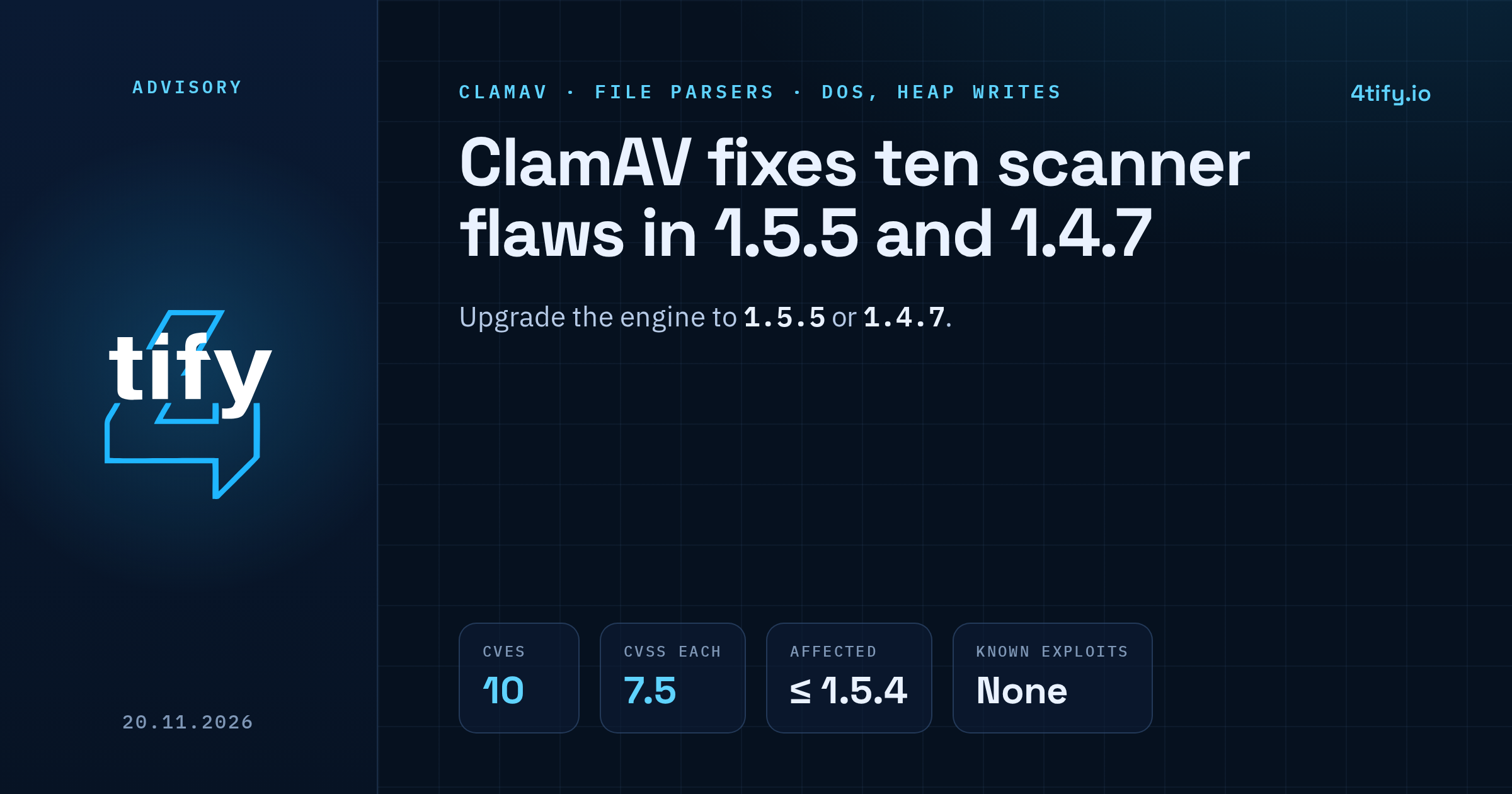
ClamAV shipped versions 1.5.5 and 1.4.7 on 18 November 2026 with fixes for ten vulnerabilities in the scanning engine. Each one can be triggered by a crafted file handed to ClamAV for scanning, and every release up to and including 1.5.4 is affected. Nothing has been reported as exploited so far.
What happened
The ten bugs sit in the parsers ClamAV uses to look inside files: email URL handling, CHM help files, OLE2 Office documents, InstallShield and XAR archives, and the UPX and yC executable unpackers. The full list, with the affected range for each CVE, is in the ClamAV release announcement.
Cisco, which maintains ClamAV and issued the CVEs, gives all ten a CVSS 3.1 base score of 7.5 (High). The vector is the same for each: network reachable, no login, no user interaction. In practice that means anyone who can get a file in front of the scanner, for example as an email attachment or an upload, can try to trigger one of them.
Who is affected
- Any ClamAV install running 1.5.4 or older. Some of the bugs go back a long way: the OLE2 stack exhaustion (CVE-2026-76417) affects every version since 0.71, and the CHM LZX heap write (CVE-2026-76421) since 0.80.
- Cisco Secure Endpoint Connector, which embeds ClamAV. Cisco rates the issues High on Windows, where the scanning process runs with elevated privileges, and Medium on Linux and macOS.
- Mail gateways, file-upload services and storage systems that call clamd or libclamav in the background. These are easy to forget because nobody logs into them day to day.
How the bugs work
Most of the ten stop the scanner from doing its job. A cyclic directory in a CHM file (CVE-2026-76414) or bad table offsets in an InstallShield archive (CVE-2026-76416) can keep a scan worker busy forever. A crafted OLE2 document can burn CPU (CVE-2026-76515) or exhaust the stack (CVE-2026-76417). A XAR archive could fill temporary storage because extraction ran before the file-count and size limits were checked (CVE-2026-76516).
A few go further. CVE-2026-76421 and CVE-2026-76430 are out-of-bounds heap writes in the CHM and UPX code. CVE-2026-76411 writes past a stack buffer while scanning crafted email, but only when full-hash phishing signatures are loaded. For CVE-2026-76422, attacker text reached the logger as a C format string. The ClamAV team says this could crash the process, leak process memory or corrupt memory. Cisco scores it as a denial of service and notes it needs debug logging switched on.
When a mail or upload scanner hangs or crashes, files can queue up or, depending on how the pipeline is configured, pass through unscanned. That is the real risk for most organisations here.
What to do now
- Check the engine version with
clamscan --versionorclamd --versionon every host that runs ClamAV. - Upgrade to 1.5.5, or to 1.4.7 if you stay on the 1.4 long-term branch. These are the only releases with the fixes. Signature updates through freshclam do not patch the engine.
- If you use the official Docker images, pull the new Alpine or Debian tags. ClamAV warned they might appear a little later than the release files.
- For Cisco Secure Endpoint, move to Connector 8.6.4 on Windows, 1.29.3 on Linux or 1.27.5 on macOS. Cisco says there are no workarounds; details are in Cisco's advisory.
- Make sure your mail or upload pipeline fails closed: if the scanner times out or dies, the file should be held, not delivered.
None of the ten CVEs is in CISA's Known Exploited Vulnerabilities catalog, and Cisco says it knows of no malicious use.
Old ClamAV builds tend to hide inside appliances and background services that never show up in a patch report. Our vulnerability scanning service maps where engines like this run across your servers and flags the ones still on an affected version, so a forgotten mail relay doesn't stay on 1.4.6 for another year.