Threat intel4 min read
Critical Tomcat bug lets an unauthenticated server join a cluster
CVE-2026-133325 affects Tomcat clusters secured with TLS 1.3 and a pre-shared key. Fixed releases are not out yet, so Apache advises switching cluster traffic to TLS 1.2 now.
4Tify Team
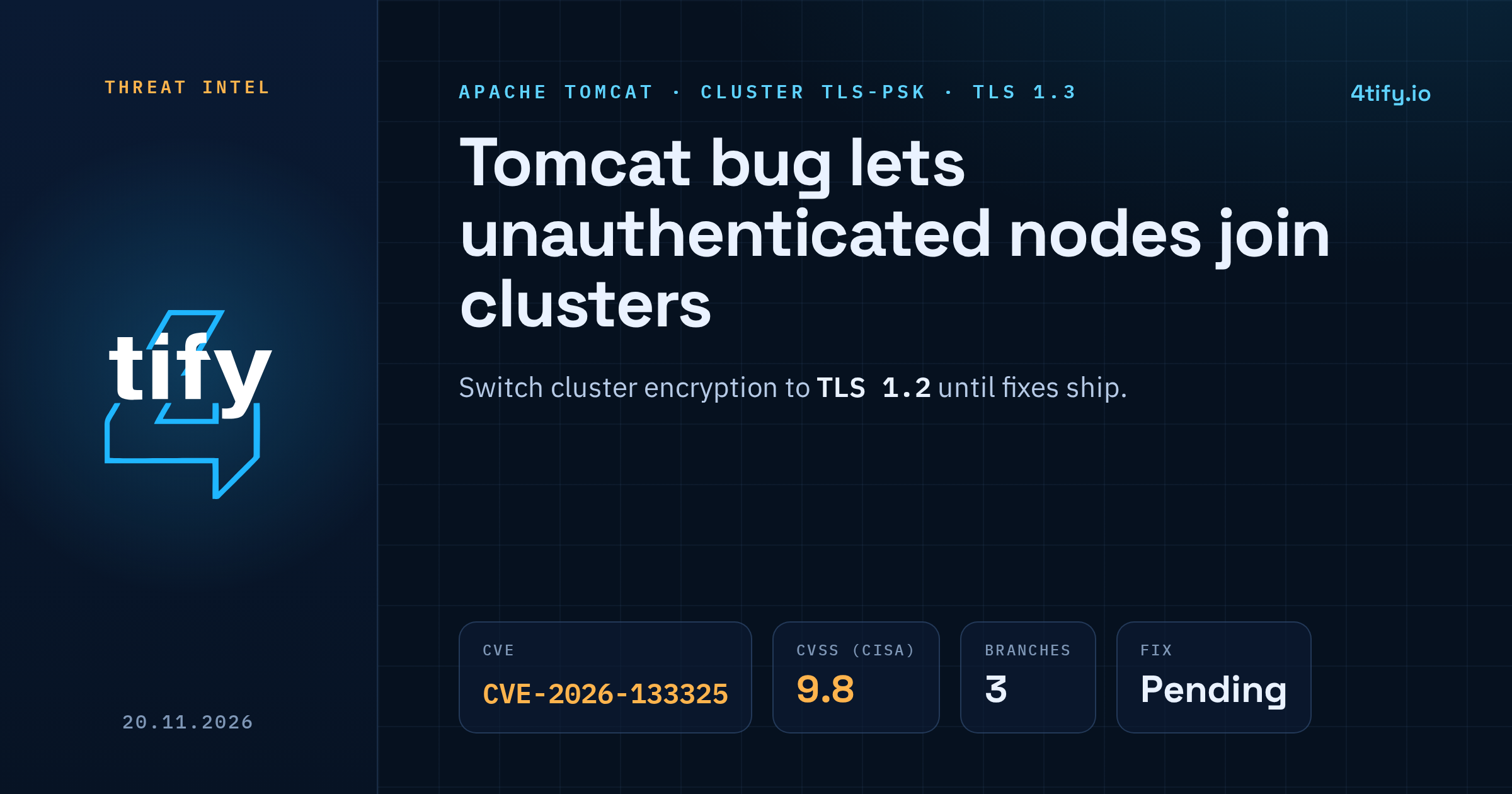
Apache has disclosed CVE-2026-133325, a critical flaw in the clustering feature of Apache Tomcat. When a cluster protects its internal traffic with TLS 1.3 and a pre-shared key (TLS-PSK), Tomcat does not check that the machine on the other end of the connection actually holds that key. A node that was never meant to be part of the cluster can join it.
The advisory went public on 19 November 2026. Patched releases are announced but not yet available, so for now the fix is a configuration change.
What happened
Tomcat clusters use a component called Tribes to pass messages between servers, most often to replicate user sessions so that a login survives when one server goes down. Recent Tomcat releases added TLS with a pre-shared key as the recommended way to secure that traffic. The older EncryptInterceptor has been deprecated after a run of its own vulnerabilities.
The new TLS-PSK setup had a gap. With TLS 1.3 negotiated, the key exchange completed without authenticating the peer. Apache classifies it as CWE-322, key exchange without entity authentication. In plain terms, the connection was encrypted, but nothing proved that the other side was a trusted member.
Apache rates the issue critical. The CISA scoring added to the CVE record gives it a CVSS 3.1 base score of 9.8 and marks it as automatable. Apache does not describe what an attacker can do once inside the cluster, and we are not going to guess. Members of a cluster do exchange session data by design, which is why an unexpected member matters.
Who is affected
Only these releases, and only when clustering is configured with TLS-PSK over TLS 1.3:
| Branch | Affected | Fixed in |
|---|---|---|
| 11.0.x | 11.0.28 to 11.0.29 | 11.0.30 (not yet released) |
| 10.1.x | 10.1.62 | 10.1.63 (not yet released) |
| 9.0.x | 9.0.124 | 9.0.125 (not yet released) |
The CVE record text mentions 9.0.123 as a fix, which looks like a typo. Apache's Tomcat security page and its announcement both list 9.0.125.
A Tomcat server that is not clustered, or a cluster that does not use TLS-PSK, is not affected. An attacker also needs network access to the port the cluster uses for replication traffic. Being able to reach a public website that runs on Tomcat is not enough on its own.
Is it being exploited?
There are no reports of exploitation so far. The flaw is not in the CISA Known Exploited Vulnerabilities catalog, and CISA's assessment attached to the CVE record lists exploitation as "none". The scores are on the NVD entry.
Keep this separate from CVE-2026-34486, an earlier Tomcat cluster bug in the EncryptInterceptor. That one has been on the CISA exploited list since August 2026. Teams that moved away from the EncryptInterceptor to TLS-PSK on the newest builds are exactly the ones who need to act on this new issue.
What to do now
- Find your clusters. Check each Tomcat instance for a
<Cluster>element inserver.xmland see whether cluster TLS is configured with a pre-shared key. Note the version on every member. - Switch to TLS 1.2. On affected versions, Apache's interim fix is to keep TLS-PSK but restrict cluster encryption to TLS 1.2. Apply it on every member.
- Check that the cluster still works. After the change, confirm that every expected member reconnects and that session replication still happens. A site can keep serving pages while its nodes have quietly stopped sharing sessions.
- Lock down the cluster ports. Replication traffic should only be reachable from the other members. Tomcat's default replication listener picks a port between 4000 and 4100. Firewall it, or keep the cluster on a private network, VPN or IPsec link.
- Upgrade when the releases land. Move to 11.0.30, 10.1.63 or 9.0.125 as soon as they are published.
- Review membership. Look through your logs for nodes joining the cluster that you do not recognise.
If you are not sure which Tomcat versions run in your estate, or whether any cluster port is reachable from outside, that is the kind of gap our vulnerability scanning service is built to find. It records software versions across your hosts and flags management and replication ports that answer where they should not.