Threat intel5 min read
Critical vCenter bypass CVE-2026-123890 was used in attacks before its patch
Broadcom has fixed a 9.8-rated authentication bypass in VMware vCenter that lets anyone with network access log in without a password. Intrusion details show a suspected China-linked group used it in September, about two months before the patch.
4Tify Team
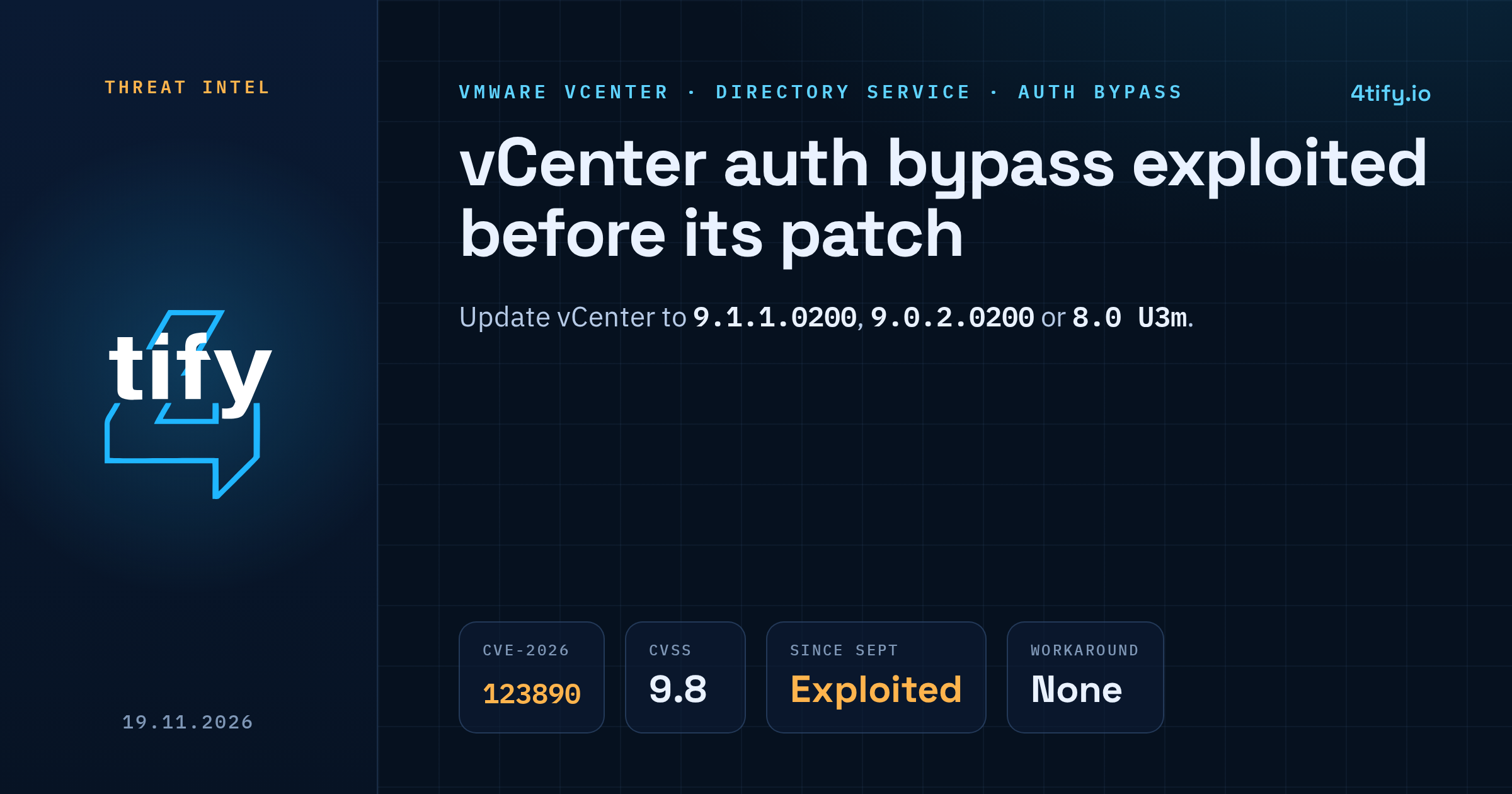
Broadcom shipped fixes on 19 November 2026 for five VMware vulnerabilities, grouped under advisory VMSA-2026-0009. The one that matters most is CVE-2026-123890, an authentication bypass in vCenter rated 9.8 out of 10. Anyone who can reach vCenter over the network can get in without a password. Technical details made public the same day show the bug was already exploited in early September by a suspected China-linked espionage group tracked as ARMORY CASTLE.
What happened
The flaw sits in the VMware Directory Service, the component behind vCenter Single Sign-On. Broadcom's VMSA-2026-0009 advisory lists no workaround, so the only fix is to update. Its FAQ classes the vCenter update as an emergency change.
The advisory itself says nothing about attacks. The intrusion analysis published alongside it describes the group first breaking into a network through a separate zero-day in a remote-support appliance, then moving to an internal Linux server. From there it used the vCenter bug to sign in as the vCenter administrator with no credentials and take over the server. That puts real-world use about two months ahead of the patch.
CISA had not added CVE-2026-123890 to its Known Exploited Vulnerabilities catalog at the time of writing. CISA's own assessment on the CVE record, added on 19 November, still listed no exploitation.
Who is affected
The vCenter bug affects:
- vCenter 9.1.x and 9.0.x in VMware Cloud Foundation and vSphere Foundation
- standalone vCenter 8.0 and 7.0
- vCenter inside VMware Cloud Foundation 5.x
- VMware Telco Cloud Platform 3.0, 4.x, 5.0.x, 5.1.x and 5.2, and Telco Cloud Infrastructure 3.0
Broadcom says vSphere 6.5 and 6.7 should be presumed vulnerable as well, since it no longer evaluates them. Enhanced Linked Mode makes no difference either way. ESX hosts are not affected, and none of the five flaws lets code break out of a virtual machine.
This is the second authentication bypass in the same directory service this year. CVE-2026-59309 was fixed on 29 July, and Broadcom says the new bug is a separate issue, so the July patch does not cover it. A second July vCenter flaw, CVE-2026-59310, is already in the KEV catalog and flagged for known ransomware use.
The other four flaws
Each of these needs an attacker who already has some access:
- CVE-2026-123891 (CVSS 8.1): SQL injection in SDDC Manager. A logged-in user can read and write database records.
- CVE-2026-123892 (7.2): command injection in SDDC Manager, letting a privileged user run commands on the appliance.
- CVE-2026-123893 (6.7): an SDDC Manager administrator can escalate to root.
- CVE-2026-123894 (6.7): SAML token signature bypass in VMware Tools for Windows. A privileged local process in a Windows guest that uses Guest Alias mapping can raise its privileges inside that VM.
What to do now
- Patch vCenter first. Fixed builds are
9.1.1.0200,9.0.2.0200and8.0 U3m. Cloud Foundation 5.x applies 8.0 U3m through Broadcom's asynchronous patching process (KB88287). Telco Cloud customers follow KB463116. For vCenter 7.0 there is no public build; customers with extended support must request one, everyone else should plan the upgrade. - Confirm the build. It's on the vSphere Client Summary tab, or in PowerCLI under
$global:DefaultVIServer.Build. These updates can't be applied with vCenter Quick Patch. Virtual machines keep running while vCenter restarts. - Watch the upgrade path. Installing 8.0 U3m or 9.0.2.0200 blocks a later move to VCF 9.1.1. Either upgrade vCenter to 9.1.1 first and patch there, or wait for VCF 9.1.2. While you decide, cut network access to vCenter down to the admins who need it.
- Update the rest. SDDC Manager goes to
9.1.1.0200,9.0.2.0100or5.2.5. VMware Tools on Windows guests goes to13.1.5.0or12.5.5. Turning off guest operations does not mitigate the Tools bug. - Look back. The bug was used before any patch existed. Check vCenter for single sign-on admin accounts nobody created and for logins from internal servers with no reason to talk to it. If you can't rule out access, rotate vCenter credentials and the single sign-on signing keys.
- Limit who can reach vCenter. Management interfaces belong on a dedicated admin network, not open to general servers or the internet.
The CVSS vector and affected ranges are also recorded on NVD.
Unpatched vCenter builds tend to sit on internal networks that nobody scans. Our vulnerability scanning service maps management appliances such as vCenter and SDDC Manager across internal and external ranges and flags builds below the fixed versions, so a gap like this one shows up before an attacker finds it.