Threat intel5 min read
Exposed CyberStrikeAI workspace shows 221 tool runs after approval gate was switched off
A leaked CyberStrikeAI database records an AI hacking agent running 221 tool executions on 16 November 2026, with its approval check disabled partway through. Here is what it did, what it only claimed, and what to watch for.
4Tify Team
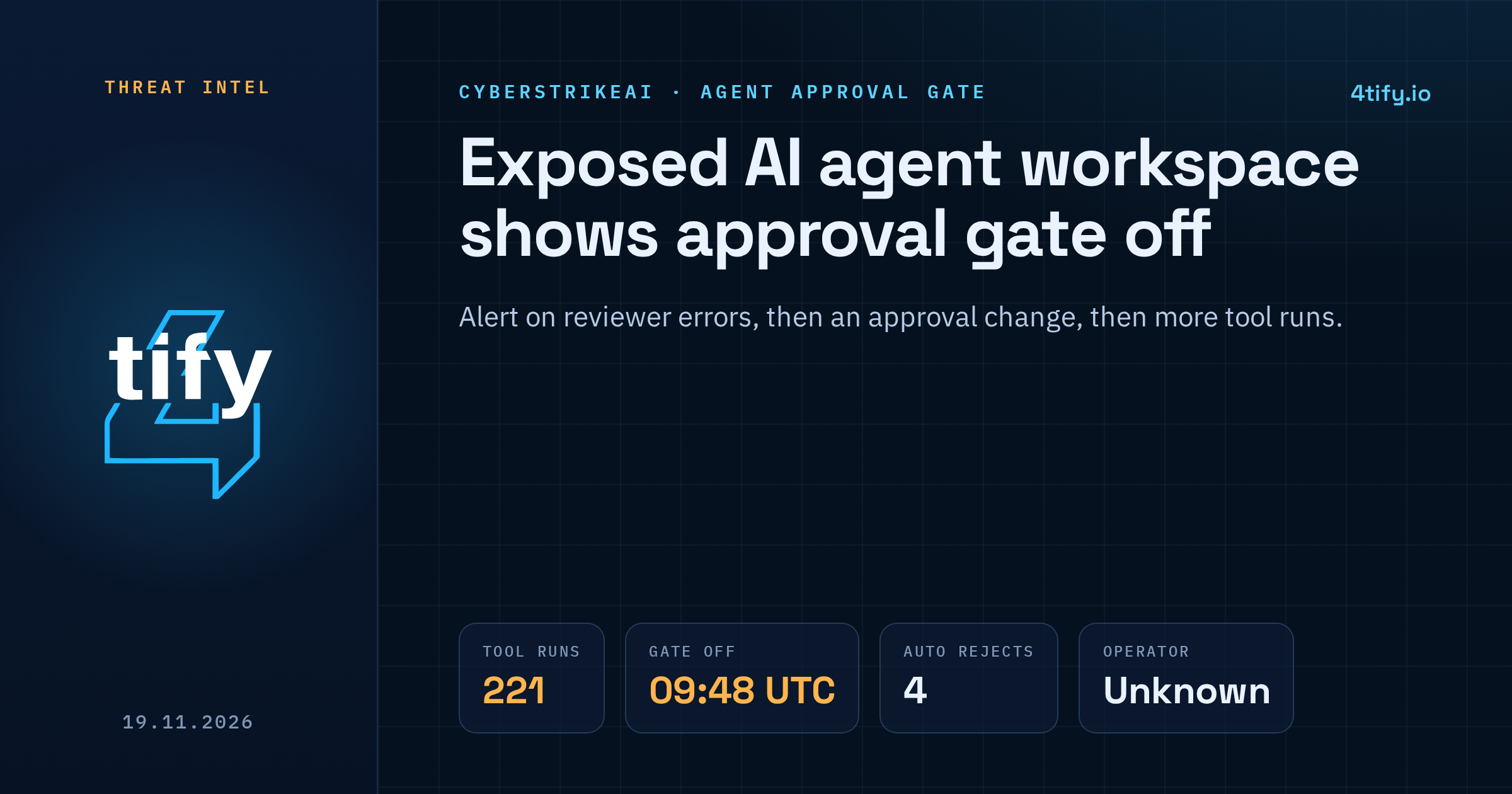
An internet-exposed CyberStrikeAI workspace has given defenders a rare, detailed look at how an AI hacking agent behaves once its approval gate stops working. The workspace's conversation database records a single session on 16 November 2026 in which the agent ran 221 tool executions, and for most of the afternoon no software control stood between the agent and its tools.
What happened
CyberStrikeAI is an open-source penetration testing framework written in Go. It connects a language model to security tools over the Model Context Protocol (MCP), stores what those tools return, and ships with an approval step meant to hold risky actions until someone signs off.
On one server running it, the framework's data and log folders were readable through a separate file service, outside the login-protected application. The exposed files included a 6.69 MB SQLite database, that day's diagnostic log and the application code. They were reviewed read-only. Nobody replayed the operator's requests or touched the systems being tested.
The database holds one conversation of 16 messages. The agent runtime logged 240 tool calls. Of these, 221 match stored execution records. The other 19 were local housekeeping such as plan updates and file reads. Every call came from a single main agent, even though the workspace was set to a multi-agent "supervisor" mode.
How the approval gate failed
The first stored execution started at 08:40:19 UTC. Four approval requests were then rejected, and none of those rejections came from a person. Each was issued by an automated reviewer that could not get an answer from its own model and refused by default. Three timed out after 90 seconds and the fourth ended when the operator cancelled the run.
At 09:48:15 UTC the saved configuration shows approval enforcement switched off. The records do not show who made the change, and there is no sign that the agent disabled it on its own. From then on, tool calls ran without a per-action check.
A human was still in the loop through chat. The operator kept pushing for deeper access, asked the agent to list harmful write and delete actions, and approved the whole list in one message at 10:18 UTC. That is direction. It is a weaker guarantee than a gate that blocks each tool call until a decision is logged.
What the agent actually achieved
Of the 221 executions, 209 were marked completed and 12 failed. "Completed" only means the tool finished running. Several completed runs returned authentication or input errors.
The best-supported result is compute-node and job data pulled from an MCP interface. The retained evidence does not show a remote shell, access to an internal network, a data-lake breach, stolen funds or a destructive database change.
The agent's own report overstated things. It logged nine findings, two of them rated critical, none independently validated. A search response saying "at least 10,000 matches" was not 10,000 downloaded records. A script that reported 260 node entries never checked for duplicates. Who ran the session, and whether the testing was authorised, is unknown.
Why it matters if you run AI agents
The same pattern can appear in legitimate deployments. A reviewer that fails safely is useful only while it stays switched on. An agent can do real work and still exaggerate what it did. Three records need to be kept apart: what was asked in chat, what actually executed, and what the output proves.
What to do now
- Alert on the sequence. Treat reviewer errors, followed by a change to approval settings, followed by more tool activity, as one event worth investigating.
- Log who changes policy. Record the user, the time and the previous value whenever approval or tool permissions are edited.
- Enforce approval outside the model. Tie each approval to a specific tool, target and set of parameters, and keep it out of reach of the agent itself.
- Keep the evidence. Store response counts, stable record IDs and the returned data or its hash, so a claim like "dumped 10,000 records" can be checked.
- Look for exposed agent data. Check whether static file servers, backup paths or dev services publish conversation databases, uploads or runtime logs, even when the main app requires a login.
- Start small. The joint guidance CISA and partner agencies published in May 2026 advises against giving agents broad access and recommends low-risk use cases first. The UK's guidelines for secure AI system development cover logging and access control for deployed AI.
An open data folder on a server is exactly the kind of exposure that never shows up in the application's own login screen. Our Attack Surface Management service maps what your hosts actually publish, including forgotten file services and backup paths, so a leak like this one is caught before someone else reads it.