Threat intel5 min read
GhostMap eBPF rootkit hides IronWorm malware on Linux
A Linux eBPF rootkit inside the IronWorm npm malware hides processes, files and sockets from ps and /proc. Here is how it works and how to check your hosts.
4Tify Team
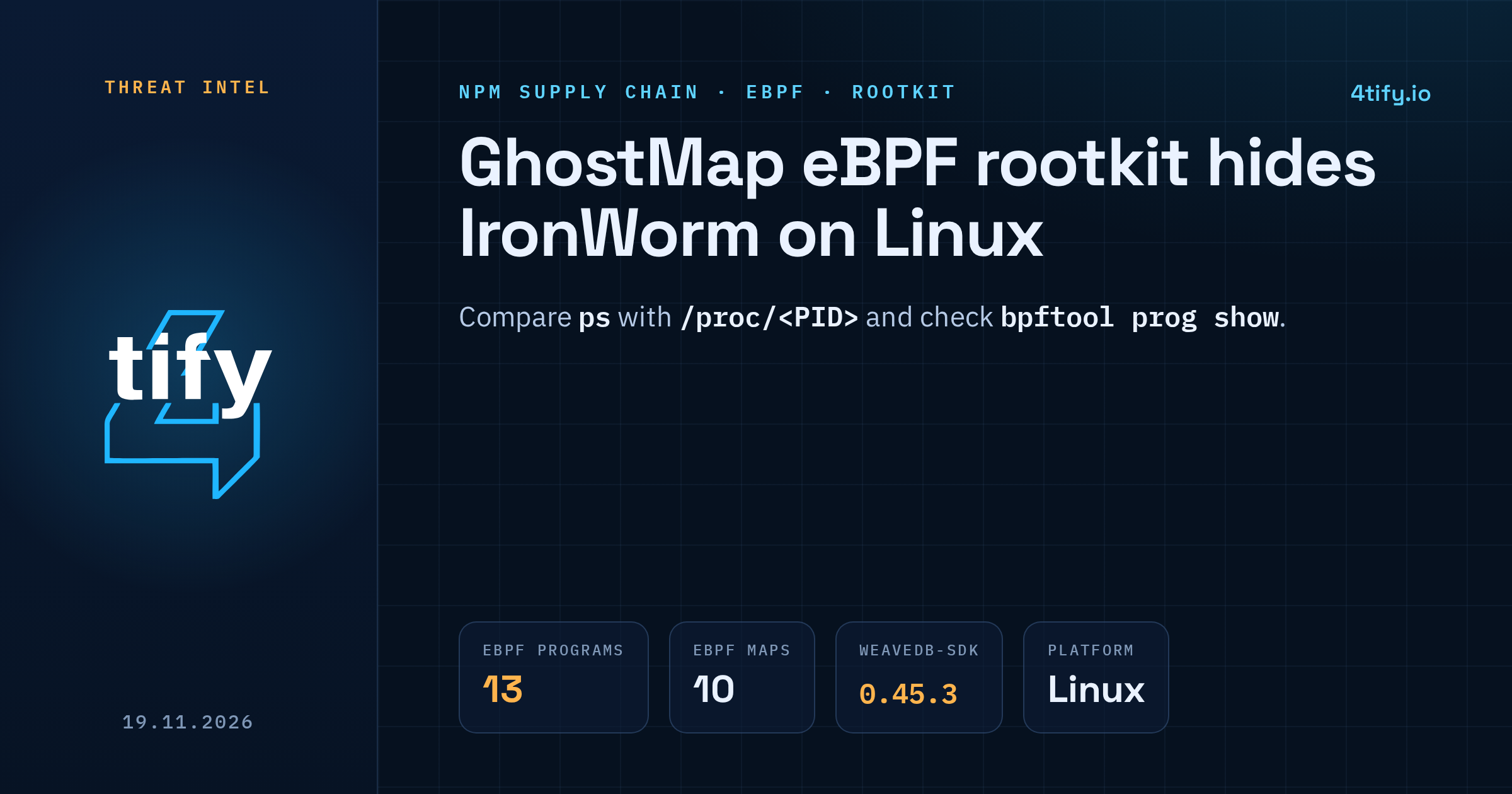
A Linux rootkit that hides malware from the tools administrators use to check a running system has been found inside IronWorm, a credential-stealing implant spread through compromised npm packages. The rootkit, tracked as GhostMap, uses eBPF to make selected processes, files and network sockets drop out of normal listings while they keep running. Details of the analysis were made public on 17 November 2026.
What happened
IronWorm is a Rust implant that reached developers through trojanized npm releases earlier this year. The analysed sample came from weavedb-sdk version 0.45.3, published on 26 May 2026. Its preinstall script runs a 976 KB Linux binary at tools/setup, so the payload starts during npm install before any code is imported. The package is listed as malicious in the OSV record MAL-2026-4723, and npm now marks that version as compromised.
The new work looked at what happens after installation. Run with root rights in a lab, the binary copied itself into a randomly named folder under /var/lib, created a systemd service and enabled it. The process started by that service, not the installer, then loaded GhostMap. Anyone tracing only the installer's child processes would have missed it.
The test did not show privilege escalation or a way to load the rootkit without root.
Who is affected
- Linux machines that installed
weavedb-sdk@0.45.3or other IronWorm-trojanized npm releases, especially developer laptops and CI runners where install scripts run with broad rights. - Arch Linux users who built packages from tampered AUR build scripts in the separate Atomic Arch campaign, which pulled in a malicious npm dependency called
atomic-lockfile. Its payload carries the same rootkit: 13 matching eBPF program names, 10 matching map names and a byte-identical 1,142-byte fakesudowrapper. The shared code does not prove that one group ran both campaigns.
IronWorm itself goes after developer secrets, including environment variables, cloud and API keys, and SSH keys.
How the hiding works
eBPF lets small programs run at hook points inside the Linux kernel. At one point during the test, GhostMap had 13 programs, 10 maps and 13 attachments active.
To hide a process, it waits for the kernel to return a directory listing to a program such as ps, then raises the length field of the record just before the entry it wants to hide. The reader jumps over that entry. In six altered listings only one byte changed, and the hidden records were still sitting in memory. Hidden processes vanished from ps but stayed reachable at their /proc/<PID> paths, and they came back as soon as the rootkit stopped. Hiding is triggered when a process starts a program with a matching name, so a child that only forks stays visible.
Socket hiding was less reliable. IronWorm's local collector on 127.0.0.1:8738 disappeared from /proc/net/tcp in all three checks, but the tested build of ss still listed it every time, just without the owning process. The collector saved incoming data in an extended attribute called user.d on the malware's own executable. Researchers confirmed this local storage but did not see data leave the machine or any remote command being executed.
The rootkit also defends itself: trying to attach a debugger to a protected process got the debugger killed.
An open-source eBPF runtime monitor that was already running caught the three programs that write into application memory at the moment they were attached. That was detection only, and nothing was blocked.
What to do now
- Search lockfiles, caches and artifact stores for
weavedb-sdk@0.45.3and the other packages named in the OSV entries. If you find a hit, treat the host as compromised and rotate every secret it could reach: npm and GitHub tokens, cloud keys, SSH keys and.envvalues. - Don't trust a clean
ps. Compare it with direct/proc/<PID>checks, and compare/proc/net/tcpwithss. A listener that shows in one view but not the other needs a closer look. - List loaded eBPF programs with
bpftool prog showand check unknown ones that use the write-to-user helper. Look for new systemd services that start binaries from random folders under/var/lib. - Before you remove anything, keep the files with their metadata, including extended attributes, so the stored data survives. Don't casually attach a debugger to a suspect process.
- Harden build hosts. Kernel lockdown in integrity mode blocks the eBPF helper GhostMap uses to rewrite listings. Running
npm ci --ignore-scriptson CI stops install scripts from running.
CISA's guidance on the 2025 npm worm still applies: review dependencies, pin known-good versions and rotate developer credentials.
Malicious dependencies like these are easier to catch before they run. Our AI-assisted code review checks a project's dependency tree and lockfiles for known-malicious package versions and suspicious install hooks, so a release like this one gets flagged before it reaches a build runner.