Breach5 min read
JPMorgan Chase says vendor attack may have exposed customer names and emails
JPMorgan Chase says attackers reached marketing data held by outside service providers, possibly including customer names and email addresses. Here is what is known and how to avoid the phishing that usually follows.
4Tify Team
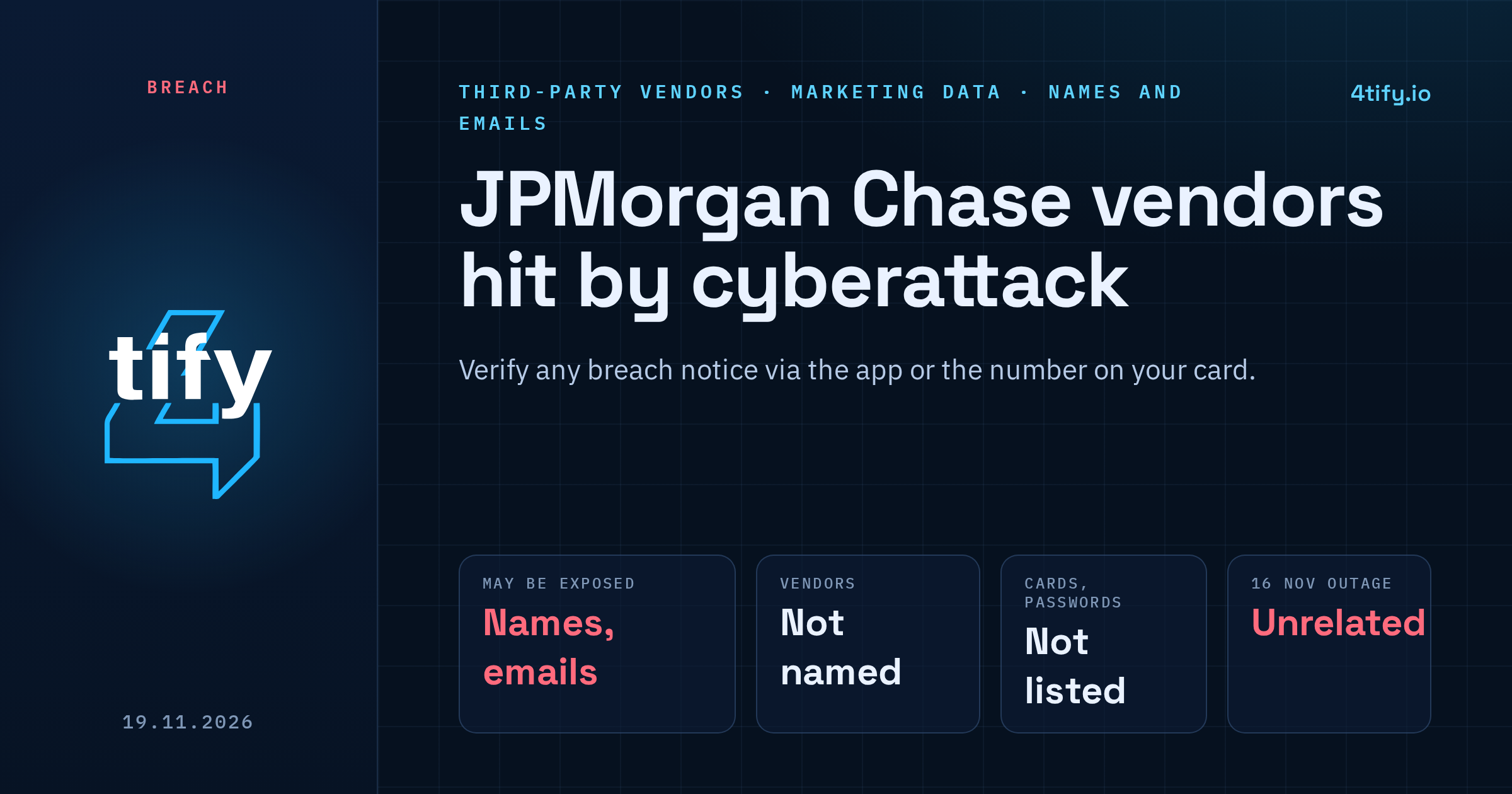
JPMorgan Chase said on 19 November 2026 that outside companies providing services to the bank were hit by a cyberattack. Its investigation so far points to marketing data held by those vendors, which may include some customers' names and email addresses.
What happened
The bank posted a short statement on its official J.P. Morgan and Chase accounts on X. It said third parties working for the firm had been targeted and that the attackers are believed to have reached certain marketing data stored on the vendors' side.
Several things are still missing from the disclosure. The bank has not named the vendors, said when the attack took place, explained how the attackers got in, or given a number of affected customers. Nor has it said whether the records were copied.
The statement did not list passwords, card numbers, account balances or transaction records among the data believed to be accessed. The bank said its banking services were not disrupted.
Not the same as Monday's outage
Many Chase customers had trouble with online banking and payments on Monday, 16 November. The bank has said that disruption came from a software bug in an on-premises hardware system and that it found no evidence of a cyberattack behind it. A bank spokesperson said there is no connection between the outage and the vendor incident.
The extortion claim
Days before the disclosure, an extortion group calling itself n0n claimed it had stolen customer and marketing data linked to JPMorgan, Visa and Mastercard, and later published files. Visa has said a third-party provider in the Asia-Pacific region was involved and that its own systems and card data were not affected. JPMorgan has not confirmed whether that leak is connected to the incident it disclosed, and the scope of the published files has not been verified.
Who is affected
So far, only customers whose details sat in the vendors' marketing systems. The bank says it will contact affected customers directly and offer support, including free credit monitoring where appropriate. It has not said when those notices will go out or how long the monitoring will last.
Why names and emails still matter
A name plus an email address will not open a bank account. It is, however, exactly what a convincing phishing email needs. Expect messages that greet you by name, mention this incident, and ask you to "confirm your identity" or sign in to claim credit monitoring. The real notices are the ones scammers will copy.
What to do now
If you bank with Chase or J.P. Morgan:
- Don't click links or open attachments in any email, text or call about this breach. Open the Chase app or type the address yourself.
- If you're unsure whether a message is genuine, call the number printed on the back of your card.
- Forward suspicious emails to phishing@chase.com and report anything odd straight away. CISA's guide to recognizing and reporting phishing covers the warning signs.
- Turn on the strongest sign-in protection your bank offers and check recent transactions.
- Chase will not ask for your password, one-time codes or full card number by email.
If you run a company that shares customer data with marketing or service vendors:
- List which suppliers hold customer records, what fields they hold and how long they keep them.
- Send vendors only the fields a campaign needs, and ask for deletion once it ends.
- Agree breach-notification terms with each supplier before you need them.
- Prepare a warning for your own customers in case your brand is used for follow-up phishing. CISA's phishing guidance is a practical starting point.
When customer data leaks from a supplier, the first sign is often a post on a leak site or a criminal forum rather than a call from the vendor. Our Deep/Dark Web monitoring service watches those channels for your domains, brands and customer records, so you hear about a third-party exposure early and can warn customers before the phishing starts.