Threat intel5 min read
Likely AI-written PowerShell toolkit swept an African stock exchange for credentials
41 PowerShell modules ran in just over three minutes on a stock exchange web server, hunting for passwords and API keys and testing them against an investment API and a securities depository gateway.
4Tify Team
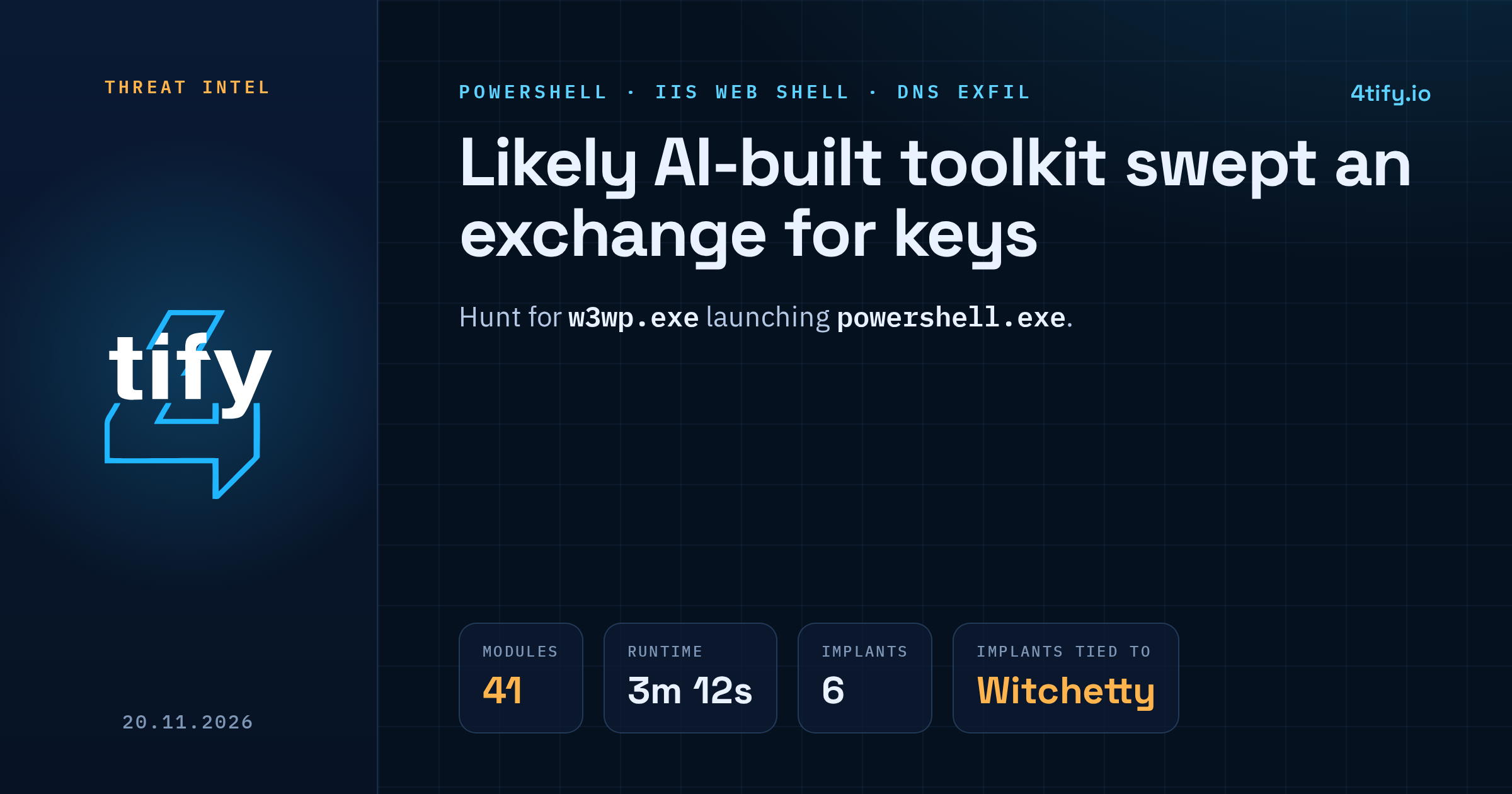
On 20 September 2026, an intruder with a foothold on a web server at a major African stock exchange ran 41 PowerShell scripts in three minutes and twelve seconds. Each script hunted for a different kind of secret, and several tried what they found against the exchange's investment API and a securities depository gateway. The analysis of the intrusion was published on 19 November. The exchange has not been named.
What happened
The scripts ran between 08:44 and 08:47 UTC through a web shell on a Microsoft IIS server, which means PowerShell was started by the IIS worker process. A new module started every few seconds. Together they:
- pulled Group Policy Preferences passwords and searched shared policy folders, plus the folders of six business applications, for AWS keys and database connection strings;
- mapped the server's IIS sites and application pools and probed a database hosted in AWS;
- enumerated SharePoint, System Center Configuration Manager (SCCM) and Team Foundation Server;
- in four modules, went after the investment API with a guessed password, a reused bearer token and several API keys tried against the depository gateway. One query checked a specific investor number.
Nothing left over HTTP. Each module hex-encoded its results and pushed them out in small chunks as DNS lookups to subdomains of a public out-of-band testing service under oast.pro, the kind of service penetration testers use to catch blind callbacks. Whoever held that token got the data. The investigators could not see that collector, so nobody knows yet whether any credential or key worked. They found no sign of privilege escalation or data theft, but the same visibility gap means theft can't be ruled out either.
Why AI is suspected
All 41 modules share one skeleton: the same error-handling line, the same try/catch wrapper, the same hex encoding and the same DNS loop, copied byte for byte into every file. Someone building a single toolkit would normally write that loop once and call it. A model asked for one standalone script at a time has no reason to. No specific model was identified, and uniform code plus fast execution does not prove machine authorship on its own. Read "AI-assisted" here as a strong inference.
Who was behind it
That is still open. Six persistence implants on the same server were tied with high confidence to Witchetty (also tracked as LookingFrog), a China-linked espionage group that had already gone after this exchange in 2022. The earliest malicious activity on the server dates to April 2026 and may go back further. The toolkit itself has not been attributed to anyone. It could be Witchetty with new tooling, another operator reusing the same access, or an unrelated intruder on a server that was already compromised. The financial targets point to money. The investor lookup keeps espionage on the table.
What to do now
Banks, exchanges and brokers running internet-facing Windows web servers can check for the same pattern today:
- Hunt for
w3wp.exestartingpowershell.exe. On most IIS servers that should never happen. Turn on process command-line logging and PowerShell script block logging so the full script is captured when it does. - Watch DNS from your servers. Alert on long hex-looking labels and on lookups to oast.pro and similar out-of-band testing domains from hosts with no reason to reach them. The token domain in this case was
danoam334iqjo0ap2scg6ofosjxfgqhsa[.]oast[.]pro. - Get secrets out of SYSVOL and app folders. Group Policy Preferences passwords can be decrypted by any authenticated domain user (CVE-2014-1812 on NVD). Delete every
cpasswordentry and rotate those accounts. Move AWS keys and connection strings out ofweb.config,.envand JSON files into a secrets manager. - Rotate what this kind of toolkit touches. API keys and bearer tokens for payment, trading or depository gateways should be short-lived, scoped and rotated after any server compromise. Alert on logins with blank or invalid keys.
- Look for web shells on public-facing servers and follow CISA's web shell guidance for detection and cleanup.
Every secret this toolkit went looking for is the kind of thing a penetration test is meant to surface first: plaintext passwords in SYSVOL, cloud keys in config files and a web server that lets an outsider run commands. Our penetration testing team checks for exactly these paths and reports each one with the fix.