Threat intel4 min read
OpenSSL Base64 flaw CVE-2026-121481: CISA says 9.8, OpenSSL says Low
A heap overflow in OpenSSL 4.x's EVP_EncodeBlock() needs an input of about 1.6 GB to trigger. CISA scores it 9.8, OpenSSL rates it Low, and no fixed release is out yet.
4Tify Team
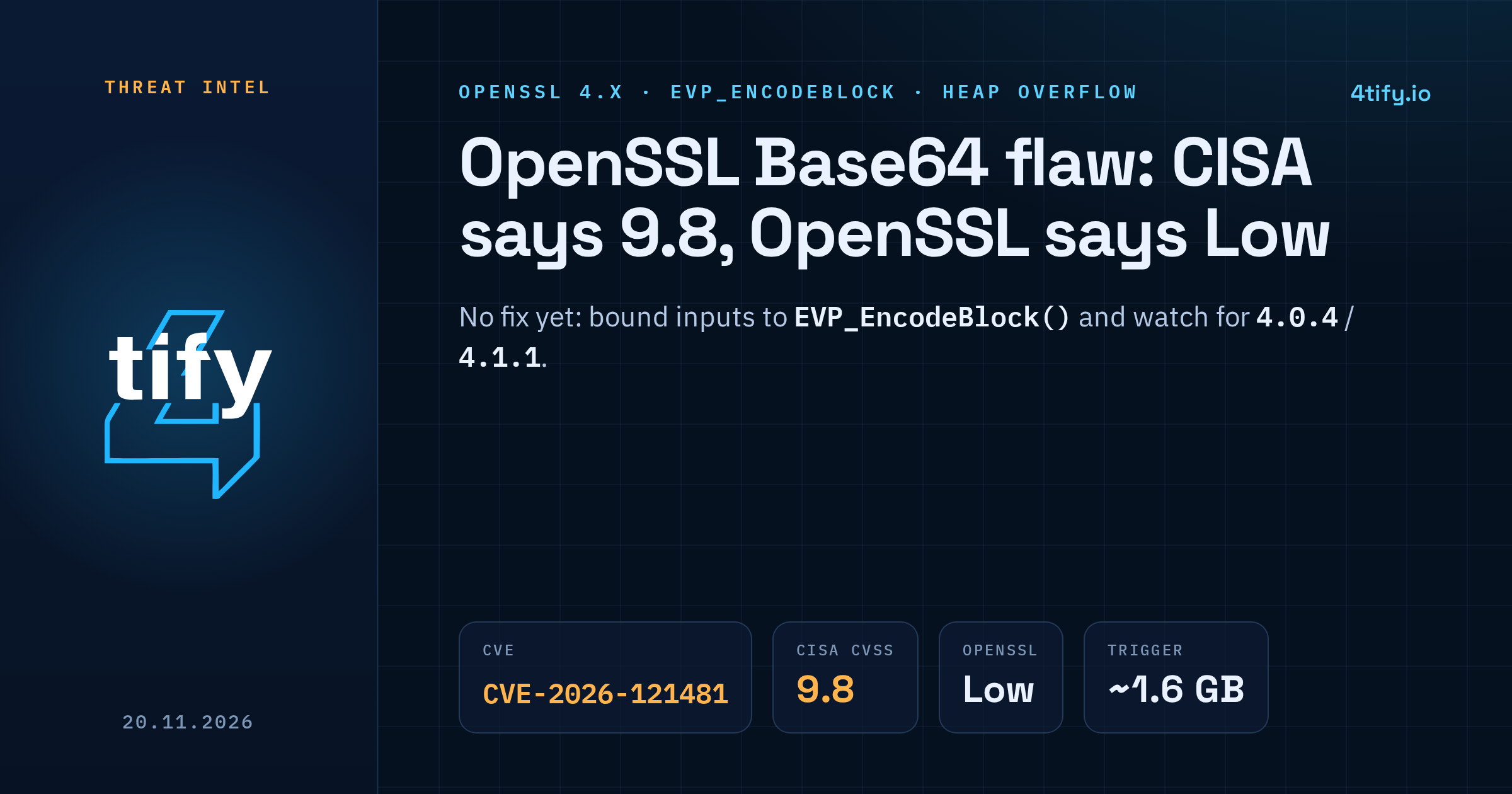
OpenSSL has a new CVE in its Base64 encoder, and the number attached to it depends on who you ask. CVE-2026-121481 was published on 18 November 2026. CISA's enrichment scores it 9.8 on CVSS 3.1. The OpenSSL project, which issued the CVE itself, rates it Low. Ubuntu sits in the middle at Medium. As of 20 November there is no patched OpenSSL release yet.
What happened
The bug is in EVP_EncodeBlock(), the function that turns binary data into Base64 text. The caller allocates the output buffer and is expected to reserve 4*((len+2)/3)+1 bytes. When the input length gets close to INT_MAX, the arithmetic that works out the encoded size overflows a signed integer. The function then writes more than the documented output size, which means a heap buffer overflow inside the application that made the call. The outcome can be a crash or corrupted memory.
To hit it, a program has to pass roughly 1.6 GB or more to a single call. OpenSSL says its own TLS, QUIC and CMS code never encodes buffers that large, and that its command-line tools can't practically be pushed there. That claim is being argued in the public fix discussion, where the reporter describes a path through a very large proxy password.
Why the scores disagree
CISA's 9.8 assumes the worst case: network reachable, no login, full impact. OpenSSL's Low rating rests on one point. Nobody has found a way for an attacker to drive the overflow, because the application itself has to supply the huge length. CISA's own decision data lists exploitation as "none", and the CVE is not in the KEV catalog. The NVD entry is still awaiting analysis.
The practical reading: a server that uses OpenSSL for HTTPS is not exposed just by doing that. The risk sits with applications that take a length from users or outside services and pass it straight to the encoder without their own limit.
Who is affected
- OpenSSL 4.0.0 through 4.0.3
- OpenSSL 4.1.0
- The 3.x branches are not listed as affected in the CVE record.
Ubuntu marks its openssl packages as "needs evaluation" on every release. It flags the nodejs package in Ubuntu 22.04 LTS as vulnerable, because that package ships its own copy of OpenSSL. Bundled copies like this are easy to miss if you only check the system library.
Patch status
The CVE record names 4.0.4 and 4.1.1 as the first fixed versions, but neither has been released. The fix, which makes the function reject inputs whose encoded size won't fit, is still under review in OpenSSL's repository, and no OpenSSL security advisory has been published for it yet. No release date has been announced on OpenSSL's official channels.
What to do now
- Find every OpenSSL 4.x copy you run: system packages, container images, language runtimes and vendor appliances that bundle their own build.
- Search your own applications for calls to
EVP_EncodeBlock(). Check that the input length is bounded before the call and that the output buffer is sized as the OpenSSL documentation describes, including the final zero byte. - For large files, encode in chunks with the streaming
EVP_EncodeUpdate()interface instead of one giant call. - Cap request and upload sizes at the application layer, so an input of that size never reaches the encoder in the first place.
- Watch for OpenSSL 4.0.4 and 4.1.1 and your distribution's updates. After patching, restart or redeploy the affected services and confirm they load the new build.
Your scanner will probably flag this as critical. Treat it as a code-path question first. Our AI-assisted code review traces where untrusted lengths reach low-level library calls like this one, which is the part a version check alone can't answer.