Threat intel5 min read
Palo Alto Networks lists Idira products hit by the Java4Shell flaw
Four on-premises Idira products ship a Java runtime affected by CVE-2026-114938. Palo Alto has fixed versions out, PAN-OS is not affected and no malicious exploitation is known.
4Tify Team
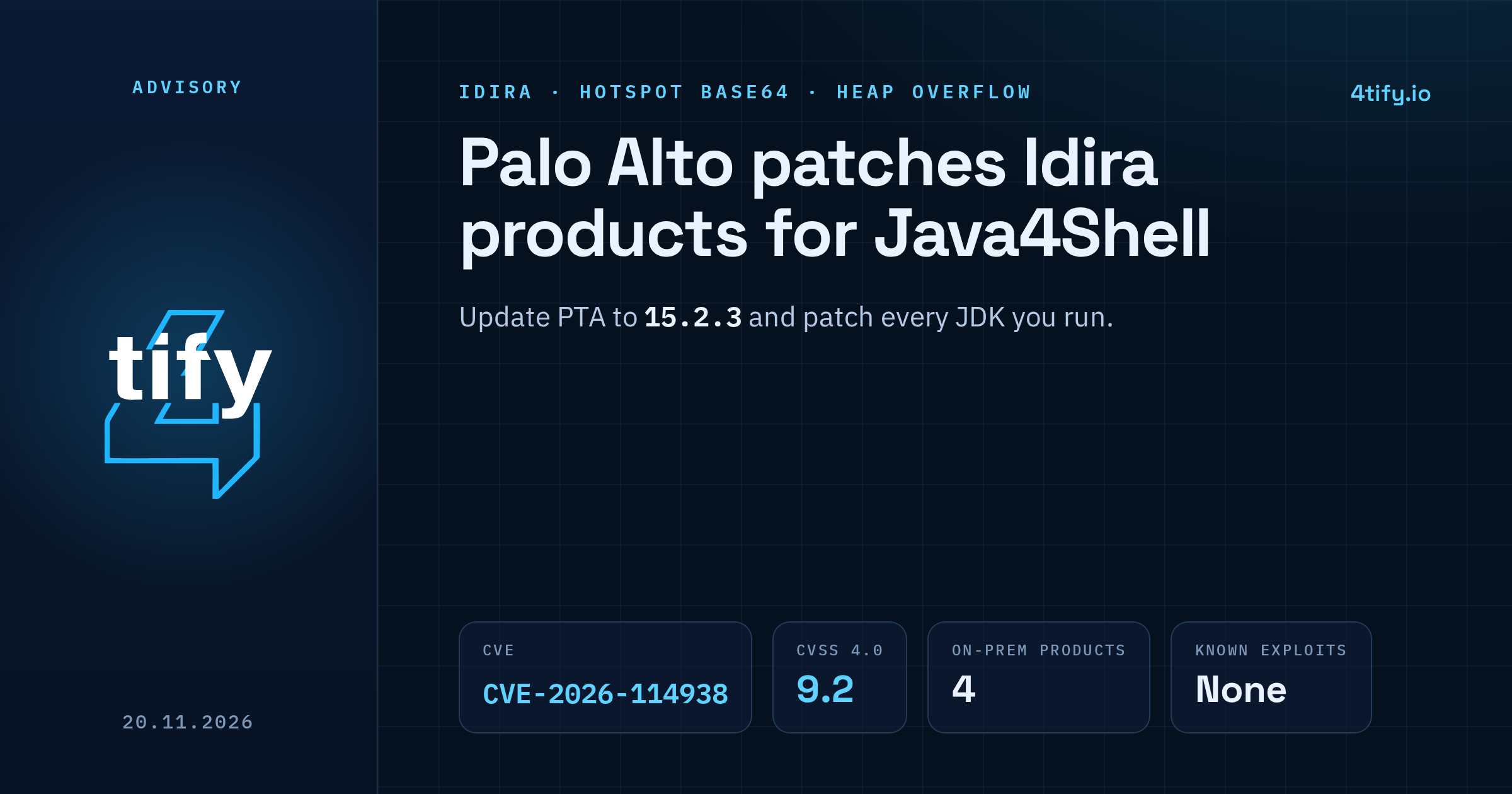
Palo Alto Networks has published a portfolio advisory for CVE-2026-114938, the Java memory-corruption bug known as Java4Shell. Four on-premises Idira products ship an affected Java runtime and need updates: Privilege Threat Analytics, Remote Access Connector, the Remote Access Connector CLI and Secure Access with an HTML5 Gateway. The company says it is not aware of any malicious exploitation.
What happened
The bug sits in the HotSpot JVM, in the hardware-accelerated Base64 decoder that Java uses on x86-64 processors with AVX-512 VBMI support. On those CPUs the fast path is switched on by default. Feeding it specially crafted Base64 input makes it write past the end of a heap buffer, and that can lead to remote code execution without any login.
Oracle and OpenJDK shipped fixes on 17 November. OpenJDK marks the Java 17, 21, 25 and 27 lines as affected; Java 8 and 11 are not. CISA issued an alert the same day asking organisations to patch immediately. The flaw is not in CISA's Known Exploited Vulnerabilities catalog, and CISA's own assessment lists exploitation as "none" so far.
Palo Alto rates the issue 9.2 (Critical) under CVSS 4.0 but sets the suggested urgency to "moderate". Oracle scores the same CVE 8.1 under CVSS 3.1. Both point to the same thing: the impact is total, but an attack only works when several conditions line up.
Who is affected
Palo Alto says three things must all be true: the product runs an affected JDK, the server has an AVX-512 VBMI CPU with Base64 intrinsics enabled, and the application decodes Base64 that an attacker can control. No special product configuration is needed, and there is no workaround for the appliances.
Affected versions and fixes:
| Product | Affected | Update to |
|---|---|---|
| Privilege Threat Analytics 15.2 | 15.2.0 to 15.2.2 | 15.2.3 or later |
| Privilege Threat Analytics 15.0 | all releases | 15.2.3 or later |
| Privilege Threat Analytics 14.6 | 14.6.0 to 14.6.3 | 14.6.4, or 15.2.3 or later |
| Remote Access Connector | before 1.1.1002202 | 1.1.1002202 or later |
| Remote Access Connector CLI | before 1.1.3701 | 1.1.3701 or later |
| Secure Access with an HTML5 Gateway (On-Prem) 15.2.2 | 15.2.2.0 to 15.2.2.16 | 15.2.2.17 or later |
| Secure Access with an HTML5 Gateway (On-Prem) 15.0.3 | 15.0.3.0 to 15.0.3.20 | 15.0.3.21, or 15.2.2.17 or later |
PAN-OS firewalls (PA-Series, VM-Series and AIRS), Panorama, WF-500-B and the PAN-DB private cloud appliance are not affected. For ADEM Infrastructure, Prisma Access MSP, Prisma AIRS, Idira EPM SaaS, Idira Remote Access and the hosted HTML5 Gateway, Palo Alto is rolling out the fix itself and customers have nothing to do. The company is still reviewing the rest of its range and says it will update the advisory.
Custom and third-party Java
The advisory makes one point worth repeating: patching a Palo Alto product does not fix the custom Java applications, third-party tools or integration scripts running next to it. Those need their own updates from whoever supplies them. The same flaw has already shown up in other vendors' products, Siemens among them, so expect more advisories of this kind.
What to do now
- Check the Palo Alto Networks advisory and move any on-premises Idira component to the fixed version in the table above. Privilege Threat Analytics 15.0 has no fix on its own branch, so plan the jump to 15.2.3.
- List every Java runtime you run, including the ones bundled inside appliances, containers and vendor software. CISA warns that these often do not show up as separate entries in a software inventory.
- Update self-managed JDKs to the November releases listed in the OpenJDK advisory, internet-facing systems first.
- On Linux, check whether a host is exposed by looking for the
avx512vbmiflag in/proc/cpuinfo. - If a self-managed Java service cannot be patched yet, it can be started with
-XX:-UseBASE64Intrinsics(or-XX:UseAVX=2). Use these flags only on x86-64; Java on ARM will refuse to start with them. Do not try this on appliances, where only the vendor fix applies. - Watch for unexpected JVM crashes and unfamiliar Java processes, which the CISA alert names as signs to investigate.
With a bug like this, most of the work is finding every copy of the runtime. Our vulnerability scanning service identifies outdated Java components on exposed hosts and in the software stacks behind them, including runtimes bundled inside third-party products, so the forgotten instances get patched along with the obvious ones.