Threat intel5 min read
PHP patches 17 security flaws, seven critical, across all branches
PHP 8.5.13, 8.4.28, 8.3.37 and 8.2.36 fix 17 advisories, seven rated critical. The PHP-FPM request smuggling bug needs no unusual PHP setting. What to check and patch.
4Tify Team
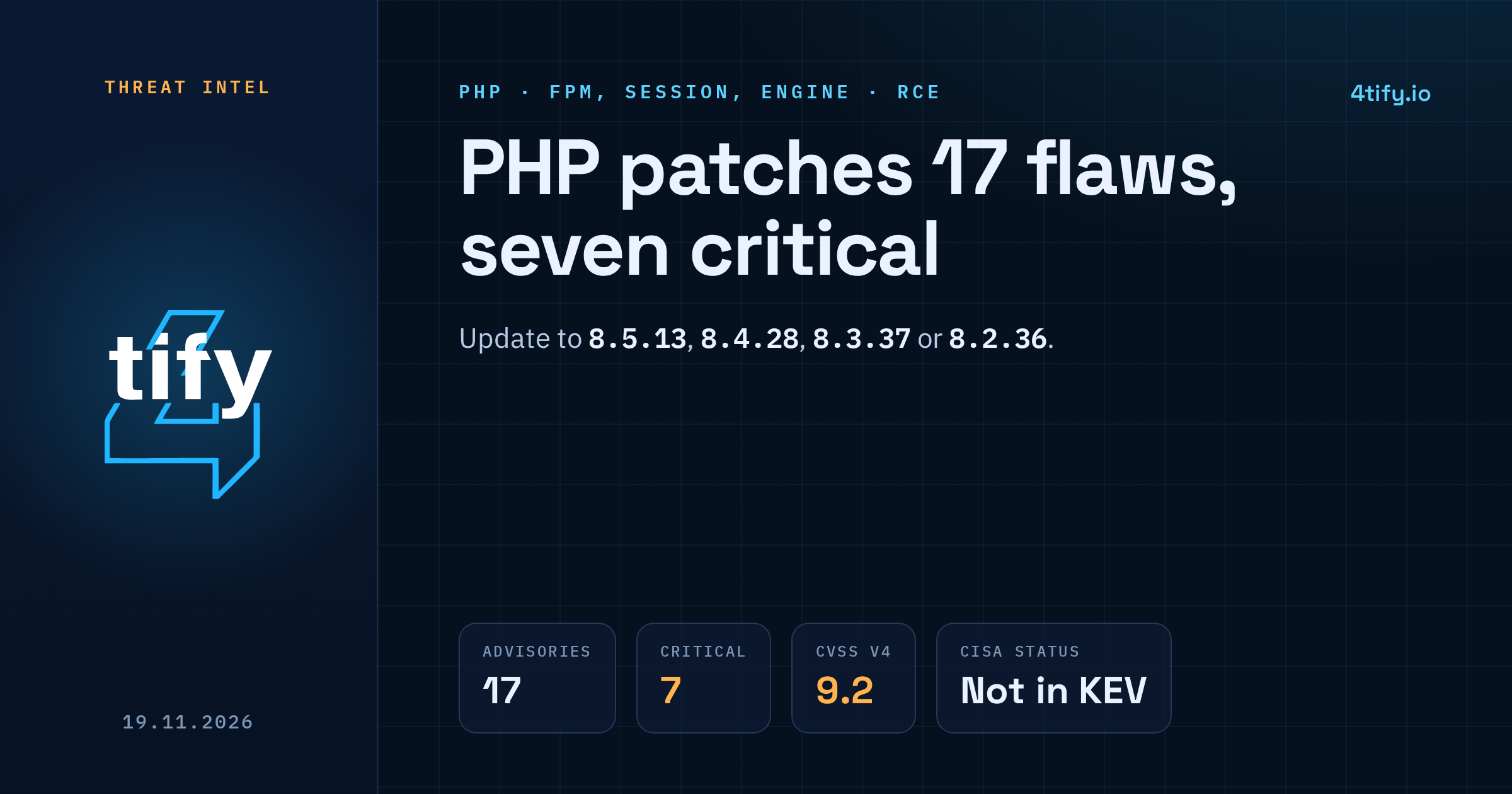
PHP shipped security releases for every supported branch on 19 November 2026. The fixed versions are 8.5.13, 8.4.28, 8.3.37 and 8.2.36, and the new PHP 8.6.0, released the same day, already includes the same fixes. The batch covers 17 security advisories, seven of them rated critical with a CVSS v4 score of 9.2.
Most of the critical bugs only bite under specific settings. One of them does not need any unusual PHP configuration at all, and that is the one to check first.
What happened
The PHP security team gave a day's notice on 18 November and published the releases in the 14:00 to 14:30 UTC window as planned. The advisories went live on the php-src GitHub repository the same afternoon. Across the 17 advisories, 7 are critical, 4 high and 6 medium. PHP 8.5 also moves its bundled uriparser library to version 1.0.3 to pick up an upstream fix.
None of the new CVEs is in the CISA Known Exploited Vulnerabilities catalog, and CISA's scoring added to the CVE records marks exploitation as "none" for all seven critical ones. October's PHP2Shell bug (CVE-2026-109619) is still the most recent PHP flaw in KEV. Two of the new critical issues are follow-ups to that fix, which closed some paths but not all of them.
Who is affected
Every supported branch is affected, but not by everything. The per-branch count from the PHP 8 ChangeLog is:
| Branch | Fixed version | Advisories fixed |
|---|---|---|
| PHP 8.5 | 8.5.13 | 17 |
| PHP 8.4 | 8.4.28 | 14 |
| PHP 8.3 | 8.3.37 | 13 |
| PHP 8.2 | 8.2.36 | 12 |
PHP 8.1 and older get no release. Those branches no longer receive security fixes, and the advisories note that some of the bugs go back many versions.
The critical issues in plain terms
PHP-FPM request smuggling (CVE-2026-129289). If the web server keeps FastCGI connections to PHP-FPM open between requests, an attacker can hide a second, forged request inside the body of the first one. This works when the application opens the request body stream and doesn't read it to the end, which some frameworks do before routing. The forged request is never checked by the front end and can run attacker-chosen PHP code as the worker. It needs no login and no special PHP setting. What it does need is connection reuse on the front end: fastcgi_keep_conn on in nginx, enablereuse=on in Apache mod_proxy_fcgi, a HAProxy setup that keeps backend connections, or LSAPI. Default nginx and Apache configurations close the connection and are not affected by the demonstrated attack, as the PHP-FPM advisory explains.
Two session bugs that can lead to code execution (CVE-2026-115560, CVE-2026-126714). One abuses session upload progress when different parts of a setup read and write the same session with different serializers. The other affects the default file-based session handler, where an interrupted write can leave a session file that mixes old and new data. Both need a usable object gadget chain in the application to reach code execution.
Memory-safety bugs in the engine (CVE-2026-129481, CVE-2026-129496, CVE-2026-129474, CVE-2026-129182). These are use-after-free flaws tied to session shutdown, the timezone cache and fatal-error backtraces. Each needs a particular combination of settings. CVE-2026-129474 and CVE-2026-129182 only affect PHP 8.5, and CVE-2026-129481 does not affect PHP 8.2.
The high-rated fixes cover a local privilege escalation in PHP-FPM, a denial of service through folded HTTP response headers, mixed-case HTTPS and FTPS URLs that could send data in plain text, and a PHAR signature downgrade.
What to do now
- Update to the fixed version for your branch: 8.5.13, 8.4.28, 8.3.37 or 8.2.36. If you use distribution or hosting-provider packages, check their notices, since backported builds may keep an older version number.
- Restart PHP-FPM or Apache after updating. Running
php -vonly shows the command-line binary. Confirm the version your web workers actually report. - Rebuild container images so new instances don't start with the old runtime.
- If you can't update today, check connection reuse. Search your nginx config for
fastcgi_keep_connand Apache forenablereuse. Turning reuse off blocks the smuggling path until you patch. - Check session upload progress. The fix turns
session.upload_progress.enabledoff by default. An explicitOnin php.ini, a pool or a virtual host overrides that. If you need the feature, make sure everything sharing a session store uses the samesession.serialize_handler. - Plan your exit from PHP 8.2. Security support for 8.2 ends on 31 December 2026, as shown on PHP's supported versions page. Patch now, then test the move to 8.3 or later.
Old PHP runtimes tend to hide in places nobody looks at often: a forgotten admin panel, a staging box, a base image that hasn't been rebuilt in months. Our vulnerability scanning service finds web-facing PHP versions across your estate and flags the ones still missing this month's fixes, so you know where to patch first.