Threat intel4 min read
PHP schedules a critical security release for 19 November
PHP will patch every supported branch on 19 November between 14:00 and 14:30 UTC. The top issues are rated critical but need non-default or uncommon setups. Here is what to check before then.
4Tify Team
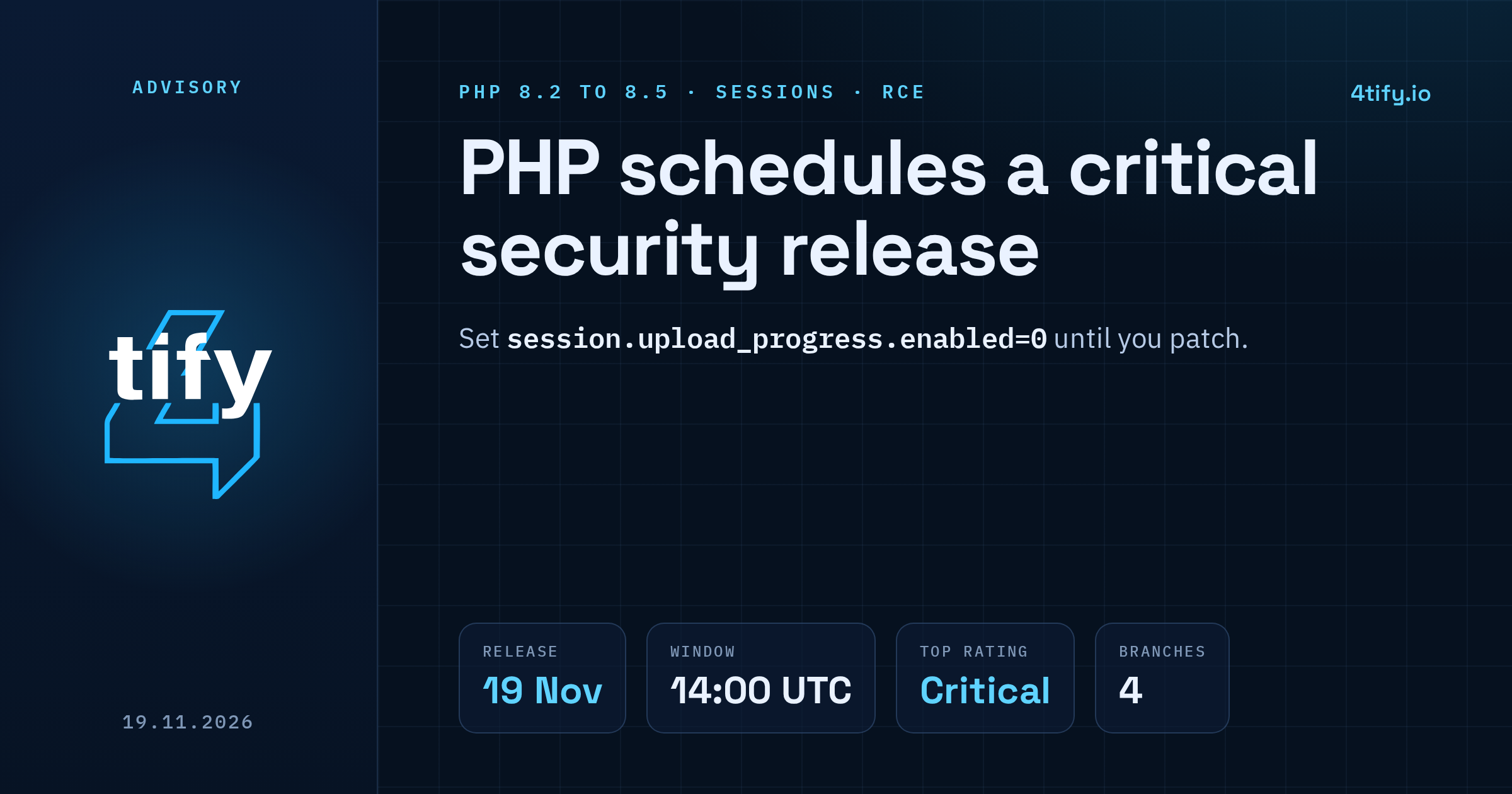
The PHP security team will ship security updates for every supported PHP branch on Thursday, 19 November 2026, between 14:00 and 14:30 UTC. The highest severity in the batch is rated critical. PHP announced the window a day early, on 18 November, so administrators can line up maintenance before the patches land.
What happened
The release is part of PHP's regular four-week cycle, not an emergency drop. PHP has not yet named the vulnerabilities or the fixed version numbers. Both will be published together with the releases. What the project has said is that the issues rated critical only bite under non-default configuration or uncommon setups.
One fix is expected in this cycle. On 23 October PHP published an informational advisory for CVE-2026-115560, a possible remote code execution path through the session upload progress feature, and said the full advisory would come with the next regular release. On the morning of 19 November the CVE record itself was still not public.
Who is affected
All supported branches are in scope: PHP 8.2, 8.3, 8.4 and 8.5. PHP 8.2 receives security fixes only until 31 December 2026, so this is one of its last patch rounds. PHP 8.1 and older get nothing from the project, and anyone still on them depends on a distribution or long-term-support vendor for backports.
For CVE-2026-115560 the conditions are narrow. All three have to be true:
- the configuration sets
session.serialize_handlertophp_binaryorphp_serialize; - the application switches it back to
phpat runtime withini_set()before callingsession_start(); session.upload_progress.enabledis still on, which is the default.
Applications that never change the serialize handler at runtime are not exposed through this path. No attacks against CVE-2026-115560 have been reported, and it is not in CISA's Known Exploited Vulnerabilities catalog.
Why it matters after October
This release lands four weeks after a much rougher one. On 21 October PHP shipped 8.5.12, 8.4.27, 8.3.36 and 8.2.35 to fix CVE-2026-109618 and CVE-2026-109619, two flaws that allow unauthenticated remote code execution on servers handling web requests (PHP-FPM, mod_php, php-cgi, FrankenPHP, LiteSpeed). Both carry a CVSS 4.0 score of 9.2. CISA added both to the Known Exploited Vulnerabilities catalog on 26 October.
If a server never got the October update, it is exposed to flaws CISA lists as exploited in attacks. Fix that before anything else on this list.
The same day, PHP 8.6.0 is due for general availability. You don't need to jump to 8.6 to get the security fixes. Updates are coming for the existing branches.
What to do now
- Confirm the October patches are in place. Every PHP runtime serving web traffic should be at 8.5.12, 8.4.27, 8.3.36, 8.2.35 or later, or on a vendor package that includes the backports.
- Apply the interim mitigation if you can. Set
session.upload_progress.enabled=0inphp.inior the PHP-FPM pool configuration. It is a per-directory setting, soini_set()in application code won't change it. Restart the PHP workers afterwards. If you already set it in October as a mitigation listed in GHSA-6wmf-4rv5-p3rp, leave it in place. - Search your code for runtime handler switches. Look for
ini_set('session.serialize_handler'calls. If none exist, CVE-2026-115560 does not reach your application. - Book a maintenance window for Thursday afternoon UTC. Once the releases are out, take the fixed version for your branch from php.net or wait for your distribution's package, then restart PHP-FPM or Apache.
- Check what actually answers requests.
php -von the command line can report a different build from the one inside PHP-FPM, Apache or a container image. Verify the version through the web server itself.
Old PHP builds hide in containers, forgotten virtual hosts and hosting panels. Our vulnerability scanning service maps which PHP versions are exposed across your domains and flags the ones behind on security fixes, so a release like this one can be checked against a real inventory instead of a guess.