Threat intel5 min read
Russian national indicted for surveilling staff of a Silicon Valley defense firm
US prosecutors say Igor D'iu took orders over Telegram to photograph employees' screens, plant a remotely accessed laptop near their office and follow staff home. He faces four federal charges.
4Tify Team
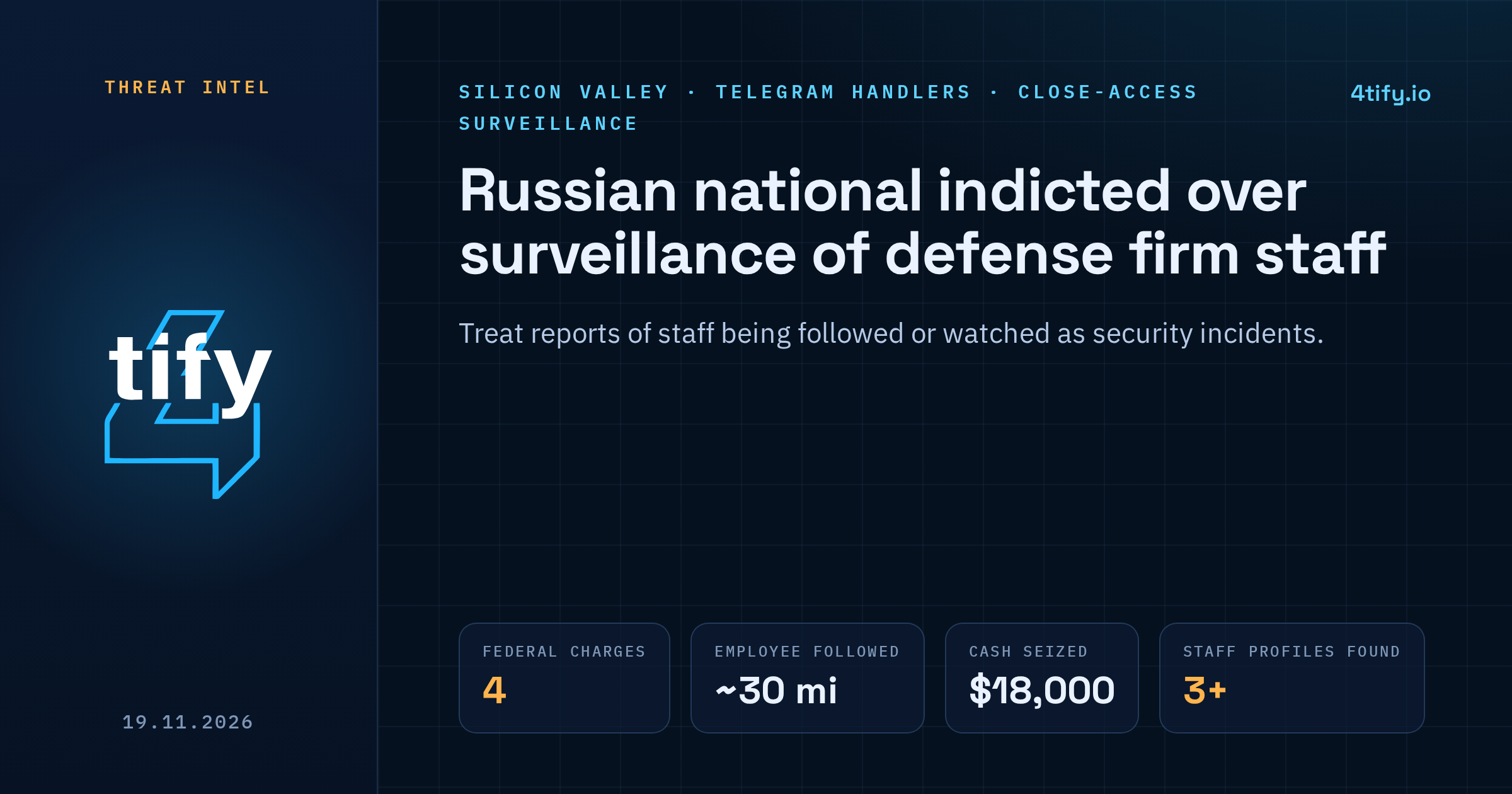
A federal grand jury in San Francisco has indicted Igor D'iu, a Russian national, on four counts tied to an alleged operation against employees of a Silicon Valley technology and defense company. The U.S. Attorney's Office for the Northern District of California announced the charges on November 18, 2026. Prosecutors say the company was picked because it supplies weapons used against Russia in Ukraine. The Justice Department has not named the company and describes it only as a large firm with an office in Palo Alto, California.
What happened
Prosecutors say D'iu was recruited over Telegram. The people directing him sent instructions, equipment and money, and told him the work was for "the Motherland". He flew from Istanbul to Mexico City in June 2026 and crossed into the United States illegally that summer with help arranged by his contacts.
Once in California, he was allegedly told to buy laptops, phones, wireless networking equipment and remote access software. His tasks, as described in the complaint affidavit:
- sit in a coffee shop near the company's Palo Alto office, pick out employees and photograph their laptop screens while they worked;
- leave his own laptop at set spots near the company so his handlers could connect to it remotely and try to collect information from employees' devices nearby;
- look up employees' home addresses online, including the address of a senior executive.
On or around September 3, he allegedly followed a female employee for nearly 30 miles as she drove from the Palo Alto office toward San Francisco. She called 911 and was directed to a San Francisco police station, and he gave up the chase once she reached an officer. Investigators say he had followed other employees on earlier days.
After Palo Alto police contacted him about that incident, D'iu allegedly switched cars, got a new phone number and moved to Reno, Nevada, on his handlers' orders, before returning to the Bay Area. Investigators also intercepted two packages from abroad holding a falsified California ID card, a genuine U.S. passport altered to carry his photo, and a Social Security card under an assumed name.
FBI searches in October turned up about $18,000 in cash, two laptops, two iPhones, two Russian passports, wireless networking gear and the forged documents. Agents also found a notebook with 10 handwritten addresses, several of them employees' homes, and detailed profiles of at least three employees covering family members, education, work history and personal strengths and weaknesses.
The charges
D'iu faces one count each of conspiracy to act as an agent of a foreign government, acting as an agent of a foreign government without notifying the Attorney General, interstate stalking, and fraud involving identification documents. The maximum penalties are 10 years for the foreign-agent count, five years each for the conspiracy and stalking counts, and one year for the document fraud count. He was arrested on October 30, appeared in court on November 2, and is due back on November 24. He is presumed innocent unless proven guilty.
What we know and what we don't
The Justice Department did not name the remote access software or say whether the handlers ever connected to the laptop. It has not reported any breach of the company's network. It also has not tied D'iu to any specific Russian agency or to the separate campaign against Western logistics and technology firms that CISA and its partners described in joint advisory AA25-141A. That advisory still matters here, because it covers the same group of targets: companies connected to support for Ukraine.
Why security teams should care
Most of this case is physical: a stranger in a café, a car in the mirror, a notebook of addresses. The technical part is simple. A laptop planted near an office can reach Wi-Fi networks, Bluetooth devices and badly configured employee machines without anyone touching the corporate network from outside. A screen photographed in public can give away names, projects and internal systems.
What to do now
- Treat reports of employees being followed, watched or photographed as security incidents, and route them to the same team that handles cyber alerts.
- Check which corporate and guest wireless networks are reachable from the street, car parks and nearby cafés, and what a device sitting there could connect to.
- Require privacy screens and locked screens for staff who work in public places near company sites.
- Cut down how much staff personal data is easy to find online, starting with executives and people in sensitive roles.
- Use CISA's insider threat mitigation guidance to connect physical security, HR and IT reporting.
Our penetration testing team can include wireless and close-proximity checks in an engagement, showing what an attacker parked near your office could actually reach.