Threat intel5 min read
Stolen bank and IRS logins pulled from infected home PCs
A Russian-speaking operation took bank, ID.me and Login.gov logins from 603 infected Windows PCs, getting past password managers and MFA on the victims' own machines.
4Tify Team
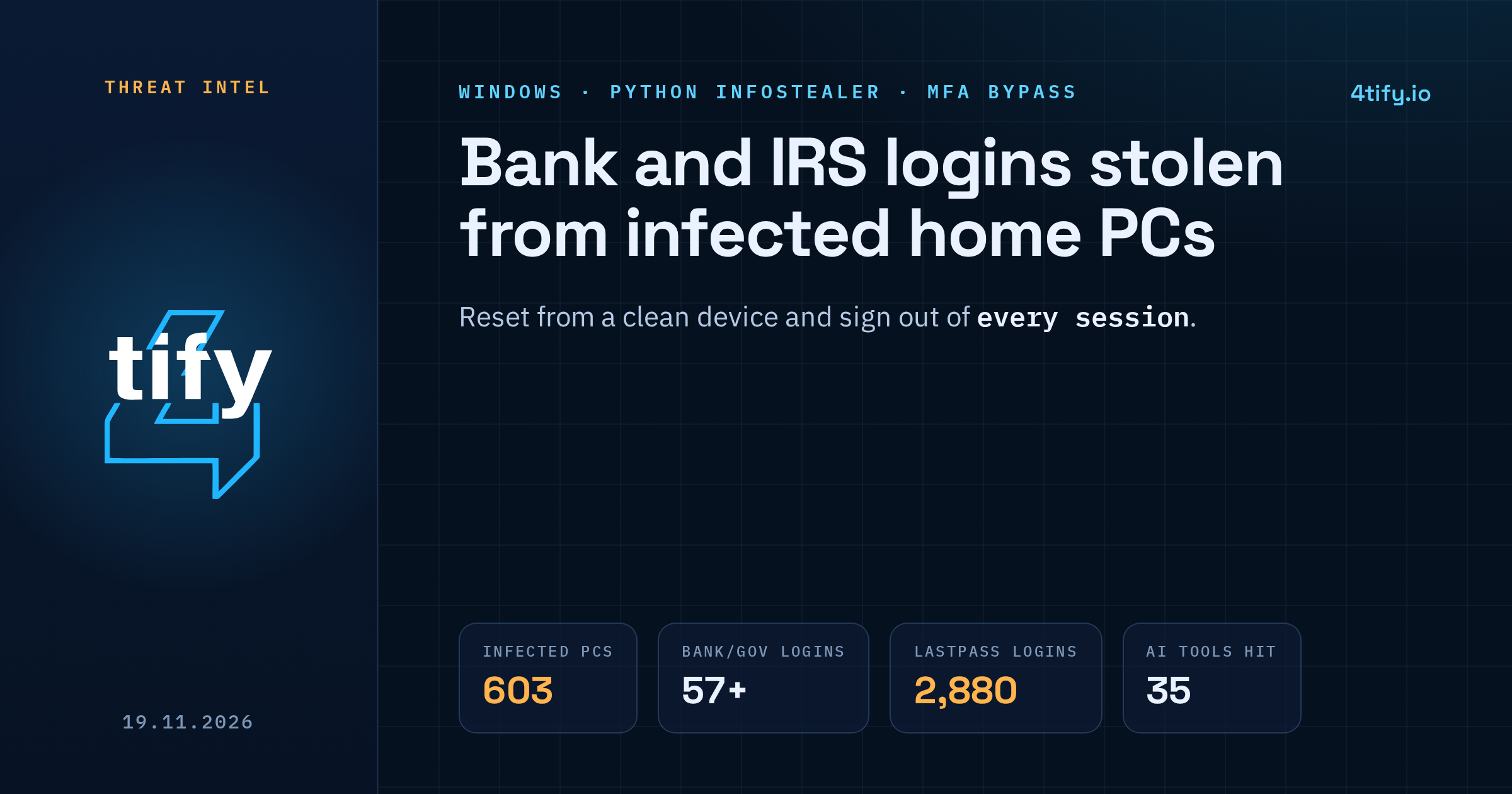
A credential-theft operation run by Russian speakers has been pulling US bank logins and federal identity accounts straight off infected Windows PCs. Its own server was left open on the internet, and the files on it show how much the attackers took: at least 57 victims had a US bank or government login in the stolen data, and at least 46 had an account with ID.me, Login.gov, the IRS or Social Security.
No bank or government agency was breached. Every login came from the victim's own computer, and many of those people were already using a password manager and multi-factor authentication (MFA).
What happened
The operation ran from 12 October to 8 November 2026. Its main server, a rented machine in the Netherlands, exposed a public directory with 1,692 files (about 1.11 GB): stolen archives, attack scripts and operator logs. The logs list 603 implant IDs spread across 469 computer names, and more than 1.2 million check-ins from infected machines.
Three home-built control systems shared that server: HavoX, which managed the implants, Phantom53, which queued tasks, and a relay called Kraken bridge that passed work to a second, external panel. Twelve Cloudflare Workers domains sat in front of everything, so the malware's traffic looked like ordinary web browsing.
Who is affected
Mostly ordinary people using their own Windows PCs. The stolen data includes:
- Banks: Chase logins in 31 victims' data, Capital One in 20, Citi in 17 and Wells Fargo in 15.
- Federal identity: about 20 victims with ID.me accounts and about 19 with Login.gov. Those two services are the front door to the IRS, Social Security and the VA, so one stolen login can reach several agencies.
- Browsers: 3,345 decrypted Chrome and Edge passwords from 16 victims, plus 30 cookie databases.
- Password managers: one complete LastPass vault with 2,880 logins (Chase, Wells Fargo, IRS.gov, Medicare and PayPal among them), the master passwords of two 1Password users, and a KeePass database copied from a developer's workstation.
- Crypto: 6,570 records from 67 victims covering 44 platforms, including Binance, Coinbase, MetaMask and Kraken.
- AI tools: saved sign-in tokens for 35 AI developer products, including Claude, Codex and Gemini. Those files can expose chat history, project files and API keys.
How it works
The first stage is a small Python script (a .pyw file) that runs with pythonw.exe from the user's AppData\Roaming folder, so no window ever appears. It arrives by phishing. The exact lure has not been made public.
Once a machine checks in, the operator sends more tools based on what it holds. Scripts copy the browser's password and cookie files and decrypt them later on the attacker's side, using hardcoded keys that defeat the app-bound encryption Chrome and Edge apply to saved passwords. Stolen Microsoft 365 session cookies were replayed to get fresh access tokens without any password or MFA prompt. That is why MFA did not save these victims: the attacker reused a session that had already passed the check.
To keep access after a cleanup, the operator installed two legitimate remote-management products, Level.io and ScreenConnect. Security tools often trust them because they are genuine commercial software, a pattern CISA has warned about before.
Russian-language comments and log text appear in 249 of the operator's scripts and logs. That points to Russian speakers, but no named group or government link has been established.
What to do now
If you think a home PC is infected:
- Use a different, clean device to change passwords, starting with email and banking, then ID.me, Login.gov and tax accounts.
- Sign out of every active session on each account. A stolen session cookie can stay valid after a password change.
- If you use a password manager, change the master password from the clean device and rotate the most valuable logins stored in it.
- Wipe and reinstall the infected PC rather than trying to clean it.
For security teams:
- Alert on
pythonw.exerunning.pywfiles fromAppData\Roaming. - Look for Level.io or ScreenConnect agents that nobody in IT installed.
- Bind sign-in sessions to compliant devices and keep token lifetimes short, so a copied cookie stops working quickly. Move staff to phishing-resistant MFA, as CISA's fact sheet describes.
- Treat AI tool login files on developer machines (
~/.claude,~/.codex,~/.gemini) like SSH keys, and keep API keys in a secrets manager.
Logins taken this way usually turn up later in stealer-log dumps and criminal markets, often before the victim notices anything. Our Deep/Dark Web monitoring service watches those channels for your company's domains and staff accounts, so exposed credentials can be reset before someone uses them.