Threat intel6 min read
Turning off HTTP/2 won't cover three of the five NGINX2Root flaws
Five NGINX bugs rated 9.2 (CVSS 4.0) can let attackers run code, and one chains to root via an unpatched Linux SCTP flaw. Disabling HTTP/2 blocks only two. Fixed in 1.30.7 and 1.31.9.
4Tify Team
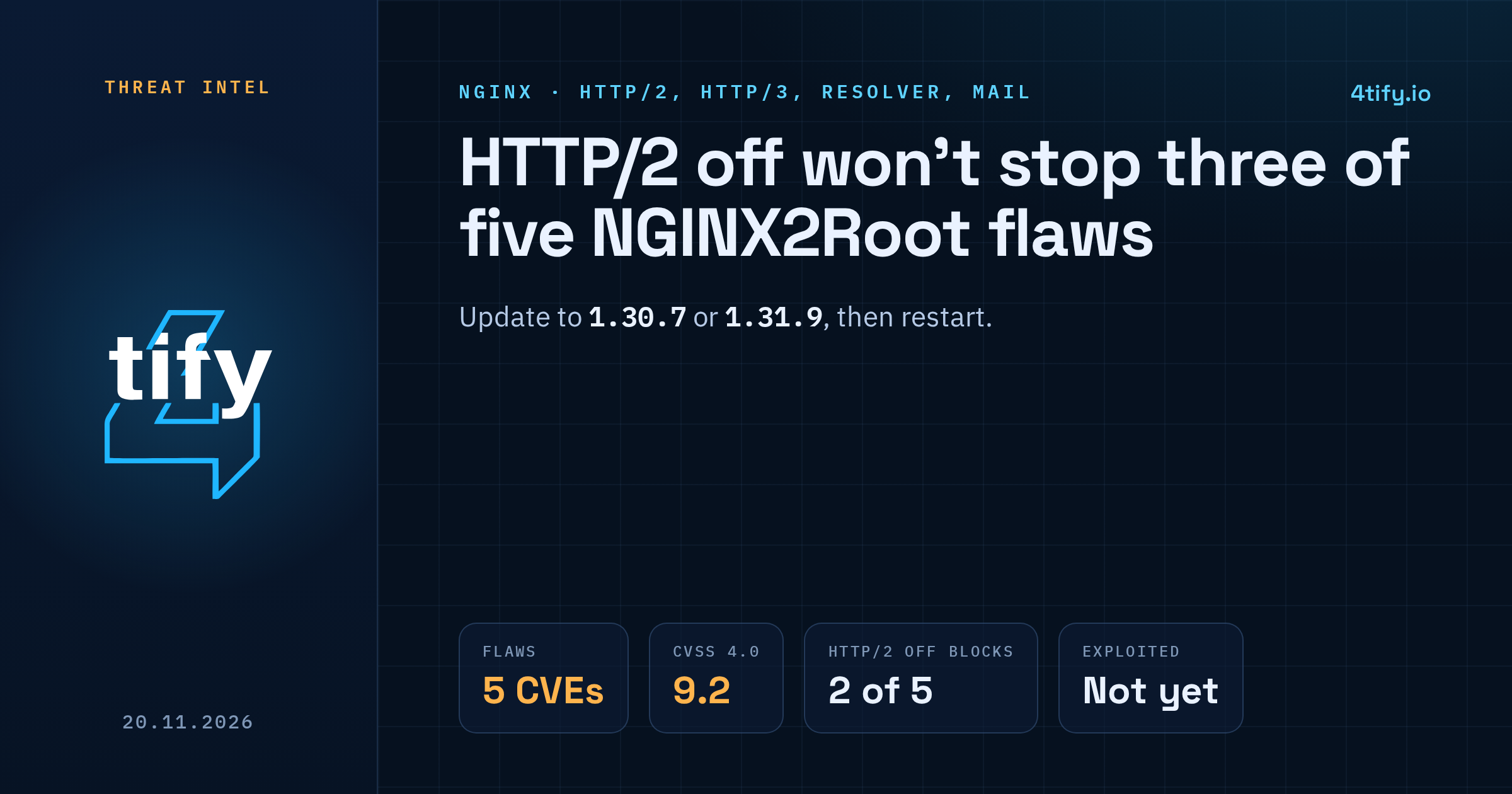
Five memory-safety bugs fixed in NGINX on 18 November 2026 now go by one name, NGINX2Root, and come with a demonstrated route from a single remote request to root on the host. F5 rates every one of them 8.1 under CVSS 3.1 and 9.2 under CVSS 4.0. Two are the HTTP/2 bugs we covered when the fixes landed. The other three sit in HTTP/3, the DNS resolver and the mail proxy, and switching HTTP/2 off does nothing for them.
What happened
All five can be reached without logging in. Each one lets an attacker crash an NGINX worker process and, where ASLR is disabled or can be bypassed, run code as that worker. They are independent of each other. An attacker needs only one, and which one works depends on how the server is configured.
The team that found the bugs went a step further. It chained CVE-2026-123007 with a separate flaw in the Linux kernel's SCTP subsystem to get root on the host. In its tests the chain also worked when NGINX ran inside a Docker container and ended with root on the underlying machine. The kernel bug has been in Linux since version 4.15, released in 2018. At disclosure it had no CVE and no fix, and most of its details are being held back until a patch exists.
The five bugs and what each one needs
| CVE | Component | Vulnerable setup | Affected NGINX versions |
|---|---|---|---|
| CVE-2026-123007 | HTTP/2 flow control | HTTP/2 enabled | 1.9.5 to 1.31.8 |
| CVE-2026-123633 | HTTP/2 | HTTP/2 with requests proxied to a backend, worker low on connections | 1.19.7 to 1.31.8 |
| CVE-2026-121810 | HTTP/3 | HTTP/3 enabled | 1.25.0 to 1.31.8 |
| CVE-2026-123634 | Resolver | Proxy to a server name built from variables, plus an SSI or mirror subrequest that resolves the same name | 0.6.18 to 1.31.8 |
| CVE-2026-113425 | Mail proxy | NGINX configured as a mail proxy | 0.5.33 to 1.31.8 |
The fixes are in 1.31.9 (mainline) and 1.30.7 (stable). On NGINX Plus, 37.0.8.1 and 37.3.0.1 cover all five. Older Plus releases from R33 onward are listed as affected with no fix of their own. The full ranges are on the nginx.org security advisories page.
Watch the numbering. 1.31.8 is vulnerable, while the lower-numbered 1.30.7 is fixed.
Is it being exploited?
No attacks have been reported yet. On 18 November CISA's SSVC assessment recorded exploitation as "none" for all five, and none of them was in the Known Exploited Vulnerabilities catalogue on 20 November. That can change fast. A public proof-of-concept exploit for CVE-2026-123007 is already out, although it needs a very large volume of HTTP/2 traffic over a single connection. A separate team showed code execution against an NGINX server that only served static files, with no backend and no extra modules.
The HTTP/2 bug has been in NGINX since 2015, so a lot of servers are in range. An internet-wide count on 10 November found 56.7 million NGINX hosts. Only 21.1% of them showed a version number, and 98.9% of those fell inside the CVE-2026-123007 range. A version string doesn't prove a server is vulnerable, though, because Linux distributions often backport fixes without changing it.
What to do now
- Patch. Move to 1.30.7 or 1.31.9, or to NGINX Plus 37.0.8.1 or 37.3.0.1. If NGINX comes from a distribution, a container image or an appliance, compare the full package version with that supplier's advisory, since
nginx -vmay still print the old number. - Restart the service. A reload re-reads the configuration but keeps the old binary in memory. Restart, do a binary upgrade or redeploy the containers.
- If you must wait, match the stopgap to the setup. Turning off HTTP/2 blocks CVE-2026-123007 and CVE-2026-123633 and nothing else. Turn off HTTP/3 where it is enabled (CVE-2026-121810), keep the mail proxy away from untrusted networks (CVE-2026-113425), and review any proxy that resolves variable server names together with SSI or mirror.
- Close the path to root. Until a kernel fix ships, block the SCTP module from loading on hosts that don't use it. This won't unload a module that is already loaded and won't help if SCTP is built into the kernel, so check both.
- Look in the right places. The HTTP/2 frames used in the attack don't show up in access logs. Watch instead for repeated worker crashes, a single long connection with heavy inbound traffic, and any program started by an NGINX worker, which is the clearest sign of a break-in.
The slow part is usually knowing which servers match which row of the table: an HTTP/3 listener on one edge host, a forgotten mail proxy on another. Our Attack Surface Management service maps your internet-facing hosts and the protocols and services they expose, so you can see where each of these five bugs applies before you patch and confirm the result afterwards.