Threat intel5 min read
Two HTTP/2 flaws in NGINX can crash workers or run code
CVE-2026-123007 and CVE-2026-123633, both rated 9.2 under CVSS 4.0, let unauthenticated attackers crash NGINX workers or run code. Fixed in 1.30.7 and 1.31.9.
4Tify Team
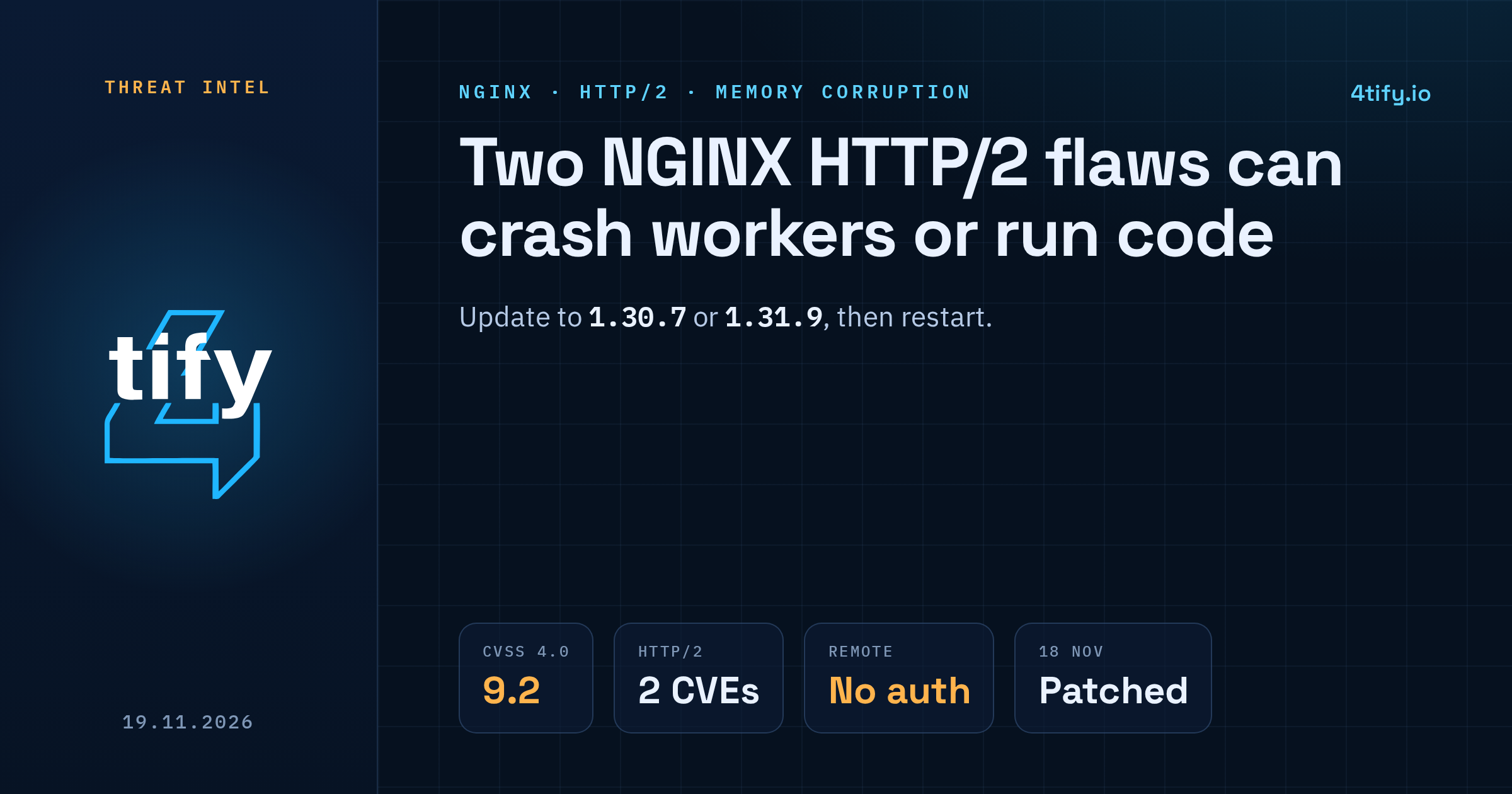
NGINX released versions 1.31.9 (mainline) and 1.30.7 (stable) on 18 November 2026 with ten security fixes. Two of them sit in the HTTP/2 module and are the ones to prioritise: CVE-2026-123007 and CVE-2026-123633. Both can be triggered remotely without logging in, and both can lead to code execution inside an NGINX worker process under the right conditions.
F5, which maintains NGINX, scores each one 9.2 (critical) under CVSS 4.0 and 8.1 (high) under CVSS 3.1. The fixes are listed on the nginx.org security advisories page.
What happened
CVE-2026-123007 is a memory corruption bug in HTTP/2 flow control. Crafted traffic can push the flow control window past its allowed limit, which can cause a heap buffer overflow. Usually the worker process then crashes. If ASLR is turned off, or the attacker finds a way around it, the bug can be used to run code. Any NGINX configuration that serves HTTP/2 is in scope. It does not need a backend or any extra module.
CVE-2026-123633 is a use-after-free. It needs three things at once: NGINX accepts HTTP/2 from clients, it proxies those requests to a backend, and the worker is running low on worker_connections. The outcome is the same range: a crash in most cases, and code execution where ASLR is disabled or bypassed.
F5 says both are data plane issues. The NGINX Plus management side is not exposed.
Is it being exploited?
Not as far as anyone has reported. On 18 November, CISA's SSVC assessment of both CVEs recorded exploitation as "none" and automation as "no", with a technical impact of "total". Neither flaw is in CISA's Known Exploited Vulnerabilities catalogue. Several research teams reported the bugs to F5 independently, some of them using AI-assisted tooling, and researchers have shown code execution in lab conditions. Patch now rather than wait for public attacks.
Who is affected
| CVE | Product | Affected | Fixed |
|---|---|---|---|
| CVE-2026-123007 | NGINX Open Source | 1.9.5 to 1.31.8 | 1.30.7, 1.31.9 |
| CVE-2026-123633 | NGINX Open Source | 1.19.7 to 1.31.8 | 1.30.7, 1.31.9 |
| CVE-2026-123007 | NGINX Plus 37.x | 37.0.0 to 37.0.7.1, 37.1.0 to 37.2.0.1 | 37.0.8.1, 37.3.0.1 |
| CVE-2026-123633 | NGINX Plus 37.x | 37.0.0 to 37.0.6.1, 37.1.0 to 37.2.0 | 37.0.7.1, 37.2.0.1 |
The CVE-2026-123007 range goes back to 1.9.5, released in 2015, so most NGINX builds in use today are affected if they serve HTTP/2. Older NGINX Plus R-series releases are listed as affected with no fix of their own. The way out there is a 37.x build that covers both CVEs.
If you installed the October fixes (1.31.7 or 1.30.6), you still need this update. Every build up to 1.31.8 is vulnerable to both flaws.
What to do now
- Upgrade. Move NGINX Open Source to 1.30.7 or 1.31.9. On NGINX Plus, 37.0.8.1 or 37.3.0.1 fixes both CVEs. Full details are in the NVD entries for CVE-2026-123007 and CVE-2026-123633.
- Check packaged copies. If NGINX comes from a Linux distribution, a container image or an appliance, wait for that supplier's patched package and confirm it includes both fixes.
- Restart, don't just reload.
nginx -s reloadre-reads the configuration but keeps the old binary in memory. Restart the service, do a binary upgrade, or roll out new containers. Then runnginx -von each instance. - Stopgap if you can't patch yet. F5 lists no official workaround. Since both bugs are in the HTTP/2 code, turning off client-facing HTTP/2 (
http2 off;, or removinghttp2from thelistenline on older versions) takes away the attack path. It can break native gRPC, so test first and turn it back on only after the update. - Start with what faces the internet. Do edge proxies, load balancers and public sites first, then internal proxies and static file servers.
Finding every NGINX instance and its real version is often the slow part, especially when copies hide inside containers and vendor appliances. Our vulnerability scanning service maps exposed web servers, flags outdated NGINX builds and HTTP/2 listeners, and rechecks after you patch, so you can see what is still unpatched.