Breach4 min read
Visa, Mastercard and JPMorgan customer files leaked after vendor breaches
An extortion group published files tied to Visa, Mastercard and JPMorgan Chase customers. All three blame outside providers and say no card numbers were taken. Here is what each company said and what cardholders should watch for.
4Tify Team
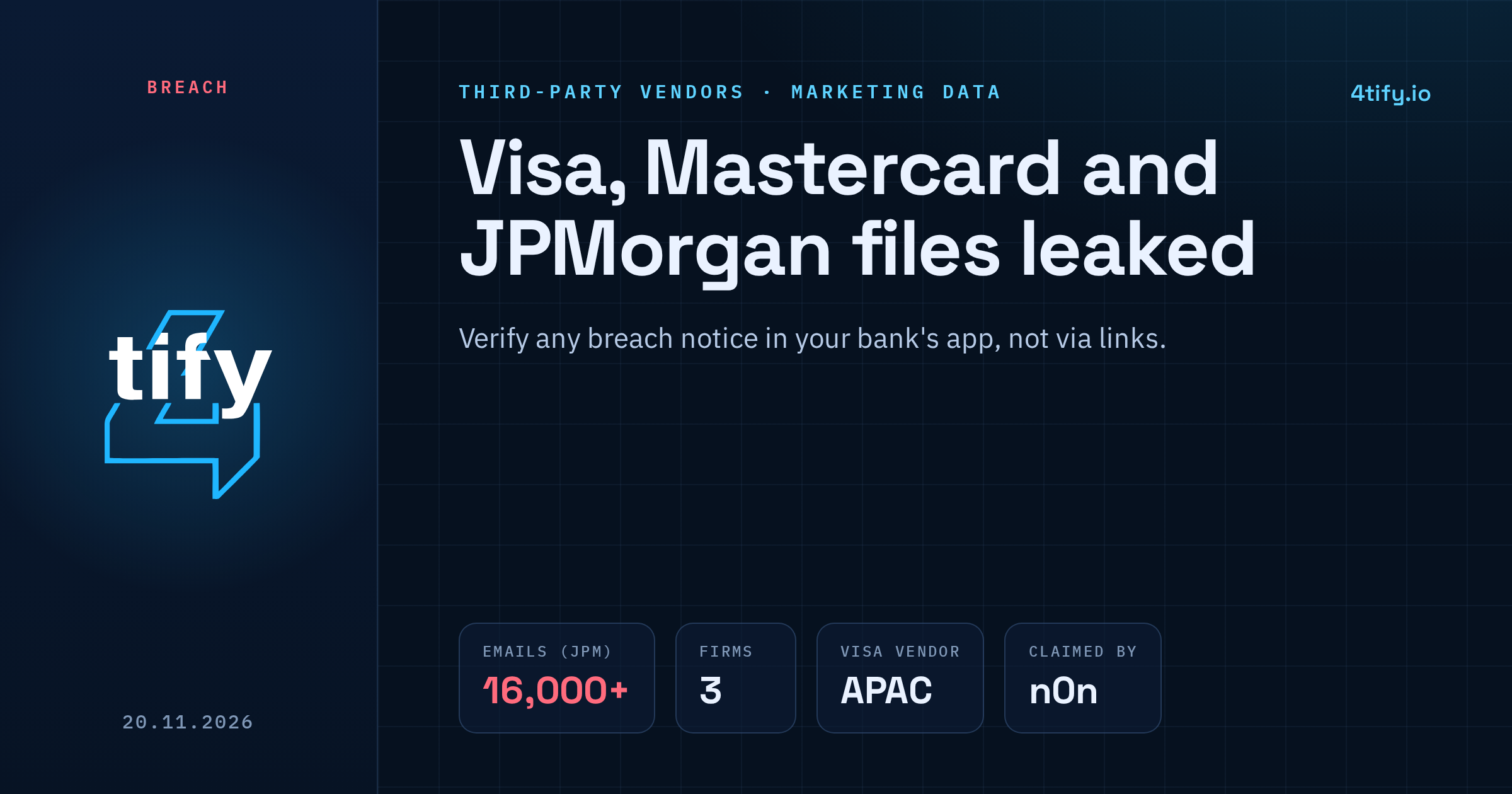
Files tied to customers of Visa, Mastercard and JPMorgan Chase were posted on an extortion group's leak site on 19 November 2026. All three companies now say the data came from outside service providers and that their own networks and payment systems were not breached.
What happened
An extortion group calling itself n0n claimed earlier in the week that it held customer and marketing data linked to the three firms. When none of them paid, it published the files. The group appeared in September 2026 and lists roughly 200 alleged victims on its leak site.
JPMorgan Chase disclosed its side of the incident on 19 November, saying vendors that provide services to the bank had been attacked and that marketing data held by those vendors was accessed. Visa and Mastercard followed with their own statements the same week.
What each company said
- Visa linked the claims to an incident at a third-party service provider in the Asia-Pacific region. It said Visa's systems were not involved and that no payment data, such as card numbers, was affected.
- Mastercard said an incident at a third-party provider exposed a limited amount of non-payment information, including email addresses, belonging to a small subset of cardholders enrolled in a specific benefit program. It said its payment network was not affected, cards keep working, and it is working with the provider to support the affected cardholders. It gave no number.
- JPMorgan Chase said the accessed marketing data may include customer names and email addresses. It plans to contact affected customers where appropriate and offer free credit monitoring, and it said the incident has nothing to do with the Chase outage earlier that week.
What is in the files
The JPMorgan-linked files hold more than 16,000 customer email addresses, and some entries also carry phone numbers and postal codes. The Visa-linked files contain thousands of apparent customer email addresses, phone numbers and marketing campaign details, mostly from Asia-Pacific markets. No comparable count has been given for the Mastercard files.
These counts describe the published files. They are not a confirmed tally of affected customers, and the full dataset has not been independently verified.
What is still unknown
None of the three companies has named the provider involved, said whether the incidents share a single vendor, or explained how the attackers got in. None has published a number of affected customers.
Who is at risk
Cardholders whose details sat in these marketing and benefit-program systems. Card numbers and passwords are not part of what the companies describe. Names, email addresses, phone numbers and the knowledge that someone holds a particular card or benefit are still enough to write a believable phishing email, text or call. Expect messages that mention this leak, a concierge or travel benefit, or a "verify your card" step.
What to do now
If you hold a Visa, Mastercard or Chase card:
- Treat any email, text or call about this leak as suspect until you confirm it yourself. Open your bank's app or call the number printed on the back of your card.
- Never share a password, one-time code or full card number with someone who contacted you first.
- Chase customers can forward suspicious emails to phishing@chase.com.
- Check recent transactions and report anything you don't recognise straight away. CISA's guide to recognizing and reporting phishing lists the usual warning signs.
If your company hands customer data to marketing, loyalty or benefits vendors:
- Keep an up-to-date list of which suppliers hold which customer fields, and for how long.
- Share only the fields a campaign needs and require deletion when it ends.
- Agree breach-notification terms and contacts with each supplier in advance. The NCSC's supply chain security guidance is a practical checklist.
- Have a customer warning ready in case your brand is used in follow-up phishing.
In cases like this one, the first sign of a supplier breach is often a listing on a leak site, days before any formal notice. Our Deep/Dark Web monitoring service watches those sites and criminal forums for your domains, brands and customer records, so a third-party exposure reaches you early enough to warn customers.