Threat intel5 min read
Wireshark 4.6.10 and 4.4.20 fix 39 security flaws
The packet analyzer's latest updates close 39 advisories, mostly crashes and hangs that a crafted packet or capture file can trigger. No exploitation is known.
4Tify Team
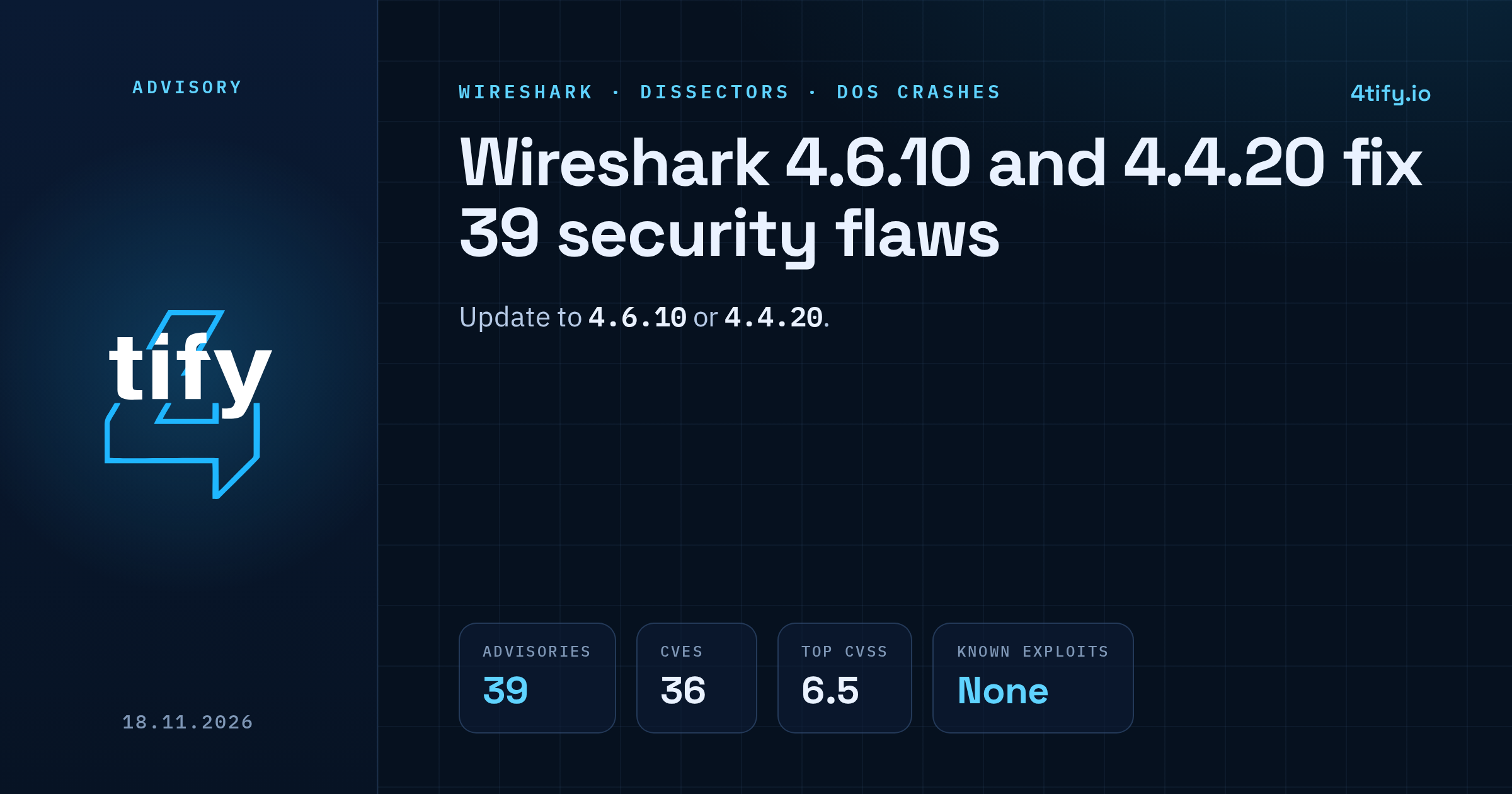
Wireshark 4.6.10 and 4.4.20 came out on 18 November 2026 with 39 security fixes, the largest single batch the packet analyzer has shipped this year. None of the bugs is known to be exploited, but most of them can be triggered by a single crafted packet or capture file, so anyone who opens traces from other organisations should update.
What happened
The 4.6.10 release notes list advisories wnpa-sec-2026-111 through wnpa-sec-2026-149. Thirty-six of them carry CVE IDs in the range CVE-2026-130434 to CVE-2026-130469. The other three (an SCTP heap memory disclosure and crashes in the iLBC and AMR audio codecs) were published without a CVE.
The Wireshark team explained the volume itself: the fixes come from an internal review and from what it called a recent trend in AI-assisted vulnerability reports sent in by outside researchers.
Who is affected
- Wireshark 4.6.0 to 4.6.9 is affected by all 39 issues. Fixed in 4.6.10.
- Wireshark 4.4.0 to 4.4.19 is affected by 36 of them. Fixed in 4.4.20. Three bugs (PEAK CAN TRC, USB-PTP and SDP) only exist in the 4.6 branch.
The same parsing code sits behind TShark and the other command-line tools, so servers and pipelines that decode traffic automatically are in scope too, not only analysts' desktops.
How the bugs work
Almost all of the flaws are denial-of-service bugs: crashes, infinite or very long loops, hangs and memory leaks in protocol dissectors and capture-file readers. Dissectors named in the advisories include RTSE, NBAP, Kafka, Matter, IEEE 1609.2, IEEE 1905, OpenWire, PROFINET, SDP, IrDA, ACN and TLS. The file readers fixed include ERF, Ascend, Android Logcat, Tektronix K12xx and PEAK CAN TRC.
Each advisory describes the same two attack paths. Someone injects a malformed packet onto a network Wireshark is capturing on, or convinces a user to open a malformed trace file. The CVE records score most issues at 5.5 (medium), four file-parser bugs at 4.7, and the IEEE 1609.2 crash at 6.5 because it can be reached over the network (CVE-2026-130461). One record, CVE-2026-130448, had not yet been published at the time of writing.
The SCTP bug is the odd one out. It can leak heap memory, and the advisory warns this could expose Wireshark to further issues.
There is no sign of attacks. Every advisory says the project is unaware of any exploits, and none of these CVEs is in the CISA Known Exploited Vulnerabilities catalog.
Other changes in the release
- The Windows and macOS installers now ship brotli 1.2.1, which fixes CVE-2026-111497.
- The Windows installer now bundles Npcap 1.89 instead of 1.88.
- The general bug list includes a LoRaWAN decryption numeric truncation issue tracked as ZDI-CAN-32851 and labelled as remote code execution. Wireshark did not publish a separate advisory or CVE for it in this release.
What to do now
- Check your version under Help > About Wireshark, or run
wireshark -v/tshark -v. - Update to 4.6.10, or to 4.4.20 if you stay on the older branch. The full list is in the 4.6.10 release notes and on the Wireshark security advisories page.
- On Linux, watch for your distribution's package update; distro builds often lag the upstream release by a few days.
- Until you have patched, treat capture files from unknown senders as untrusted input. Open them on an isolated machine, or with a fixed build.
- If you run TShark in automated jobs, update those hosts as well, and make sure a crash cannot stall the pipeline unnoticed.
Tools like Wireshark tend to live on engineers' laptops and jump hosts, outside the usual patch cycle, and old copies linger for years. Regular vulnerability scanning of workstations and servers is how our team finds those forgotten installs before an attacker does, and it flags exactly this kind of outdated analysis tool.